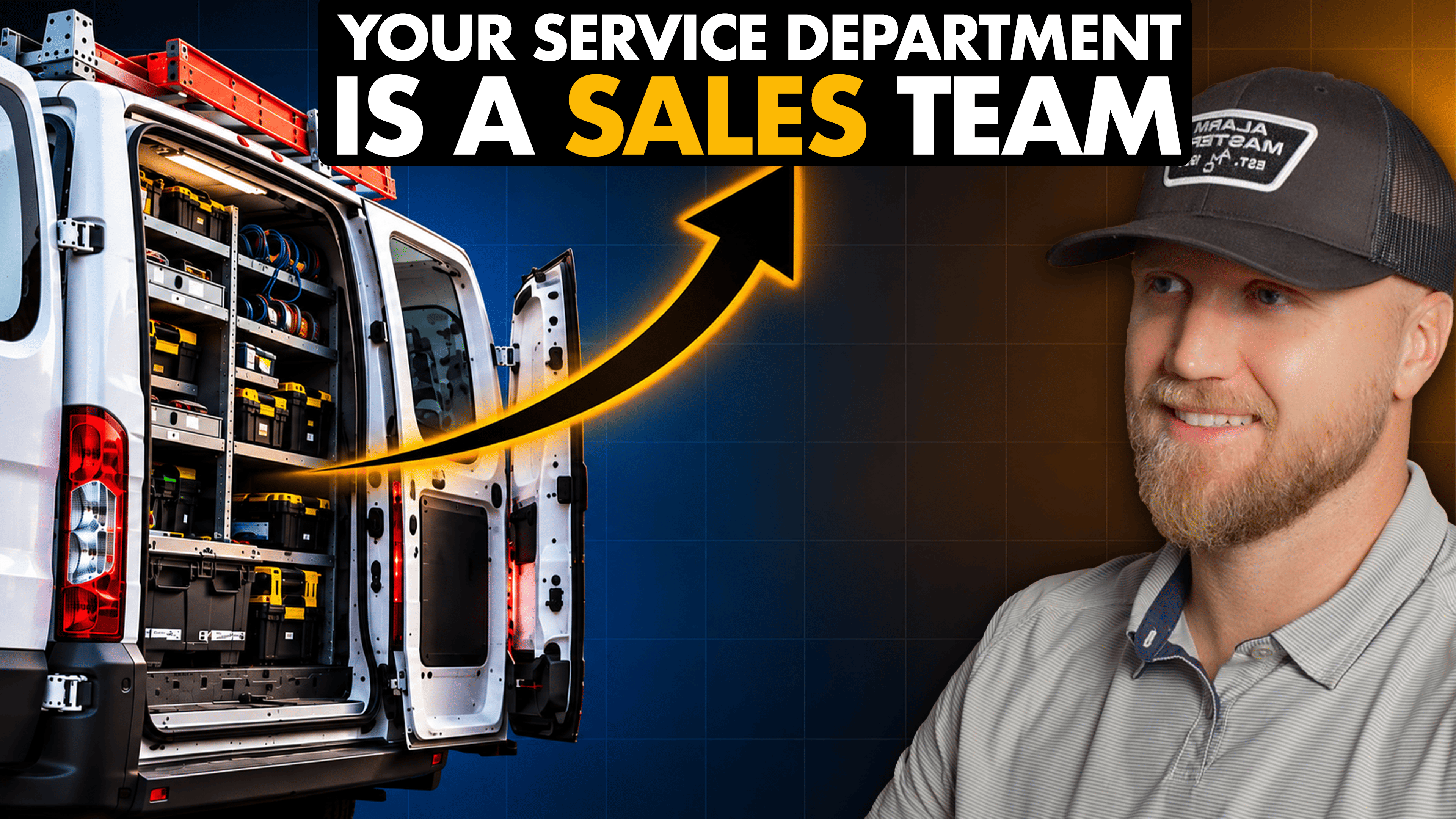


Service might be one of the most undervalued revenue opportunities in the security industry.
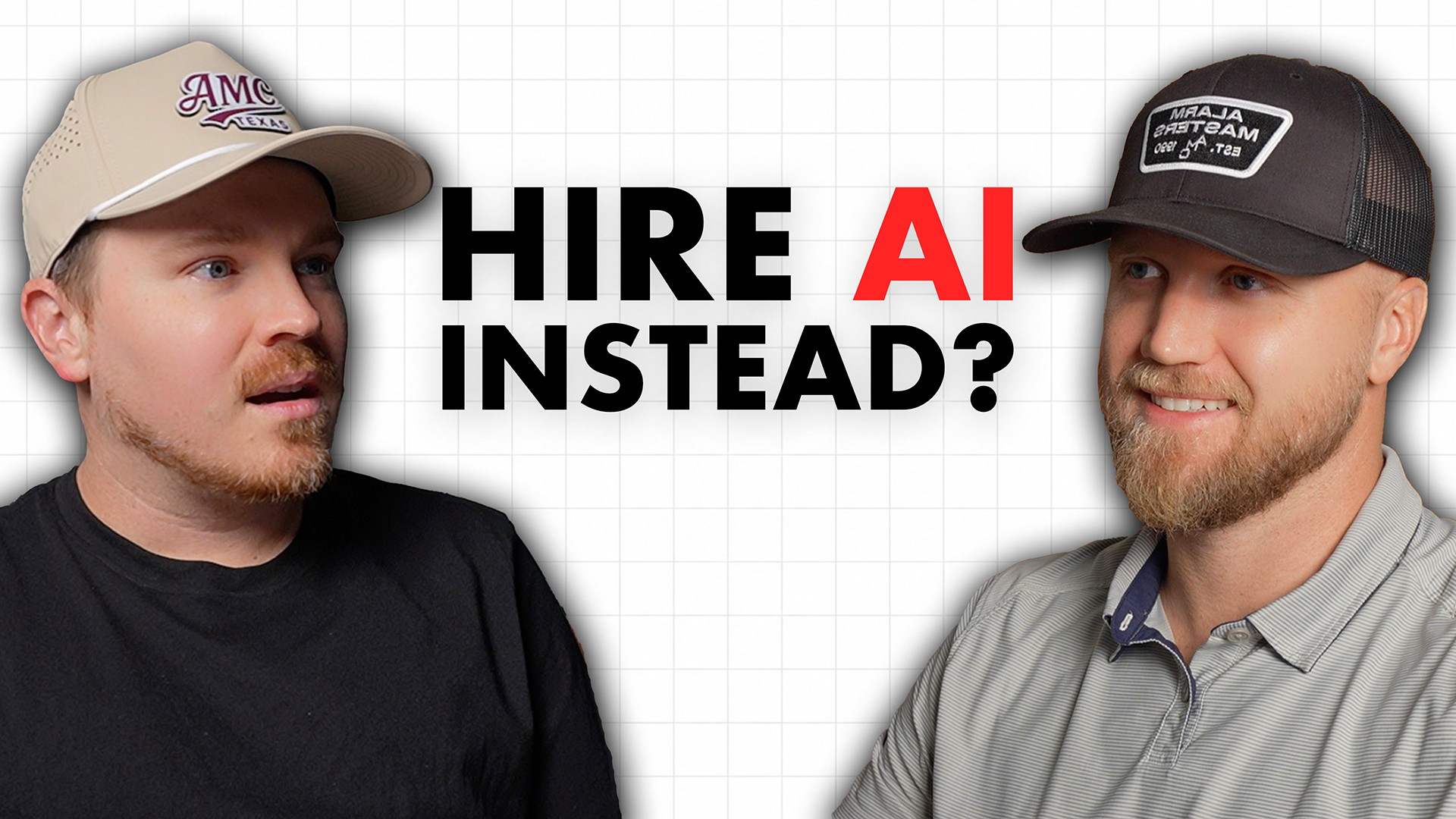
In this episode of Entry & Exit, Stephen Olmon and Collin Trimble break down why they’re changing the way they think about service revenue inside Alarm Masters. After learning that 70% of another large security company’s revenue comes from service alone, they realized they may have been treating service as a path to bigger projects instead of a major growth opportunity on its own.
They explain how service calls can create revenue, strengthen customer relationships, and uncover larger project opportunities. They also lay out their plan to build a real sales process around service, proactively work their existing customer base, and pursue new customers through service first.
In this episode:
→ Why they’ve been undervaluing service revenue
→ How 80% of their recent leads came from the service department
→ Why service needs its own sales process
→ Turning small service calls into larger project opportunities
→ Finding more revenue inside your existing customer base
→ Using proactive service to stay in front of customers
→ Winning new customers through service first
→ Alarm Masters’ goal to 4X service revenue next year
Connect:
Stephen Olmon — https://x.com/stephenolmon\
Collin Trimble — https://x.com/TXAlarmGuy
Owned and Operated
New Episodes Every Wednesday!
Subscribe For More
80% of our leads have been from our service department.
I would say we were undervaluing each new marginal service revenue dollar.
There is service revenue there that is equally as important as project, but also there's additional project revenue there that's uncovered by running a good service sales process.
I think our thinking is changing a little bit because what we have said even on this podcast in the last 12 months is service leads to sales.
But I think as an industry, we need to be focused on running sales cycles for service dollars.
The amount of service revenue that is available that we could go get, I think is like an order of magnitude greater than what we realized. And so this huge light bulb. And what you're gonna find and what we found is that people are criminally underserved.
Welcome to entry and exit. My name is Steven. I also have Colin with me, my faithful co-host and business partner. And today we are talking about the surprise enterprise value creator. The thing in our industry that most people kind of ignore or discount. But we were spending time with a friend that's been in the industry a long time, and he melted our faces with a statistic about their organization. Now, we're gonna be polite and not reveal who that is. We're not gonna give too much color on that. But what did he say, Colin? He said 70% of all their revenue, and again, this is a very large organization in our industry is what? Is service revenue not RMR revenue. Not RMR plus service. 70% of time.
Yeah, that's wild.
Um I I thought I I thought I misheard. Are you like 17? Okay, that's a little low. No. 70.
Yeah,
it's it's it was sort of a funny thing because if you would have asked me uh before about the business, I would have said, hey, one of the first things we want to do is focus on service. You we have recorded many episodes talking about how you should increase your service department. We have single-handedly doubled our service department year over year, every year since we have owned the business. So you might be thinking, well, seems like y'all have been sold out on service this whole time. And I would agree with you. Uh it has been not like that, not to this, not to this degree. We have realized I've always sort of placed service dollars down here and project dollars up here in terms of what is sexier, what is better. That's what I'm more focused on. Yeah, I look at service revenue generated every day, but I've always been like, oh, sick, we've got a $15,000 job. But then I'll hear about a $10,000 fire panel replacement some devices and I'm in service. I'm like, oh, that's cool. Uh and so I don't know why I have had that perception, but I was sitting down, having coffee with this guy, and he was like, Yeah, 70% of our business is service. And he said, We don't even do RMR, and that's the crazy part. He's like, we should be doing more RMR. And I said, wait a second, I thought that y'all did a lot of ground up because all the ground up construction we do has been a result of the customers we service. We don't really do a ton of traditional bid work. And I was just blown away by that. And I realized we uh we don't have a service sales team. What we have are three people that support the service department. We've got the service manager who's mostly over managing the technicians and kind of office the cases, the work orders, making sure that they're getting advanced invoices are correct. Uh, you know, the guys have the material, the things that they need, you know, do the stuff that they need. We've got a service scheduler, kind of service admin, and he makes sure he schedules all of our guys. He makes sure that they are closing out their tickets, they're doing the things that they need to do, getting stuff on the schedule. And then we've got an international employee that's actually calling on all of our failed to communicate and our trouble reports from all of our different vendors to set service calls. And uh we were we were for sure focused on fail to communicate, particularly in fire alarm world, but like we kind of ignored or didn't really think about burglar alarms or low bats. I mean, we would go after them, but like it was more like if we had time. Right. And and the other thing we would do is like we would get a customer that'd be like, we'd do a service call and they'd be like, hey, can I get a proposal on replacing my fire alarm system? Like we'd say, hey, you need you could either replace a couple of these devices or just replace your system because your system's really old and be like, yeah, can I get a proposal? It's like, yeah, sure. And so we'd spend, you know, we would turn it around in a couple days versus on the sales team, I would be like, hey, you gotta turn that thing around 24 hours. Right. And so I don't know why I wasn't applying
the same thing. So we we basically had this realization that we need to build a whole sales team and sales structure in our service department. Yep, because the other thing that is we've talked about on this podcast, it's just like, guys, what do y'all? Why are y'all just now coming to this realization? 80% of our leads in the last quarter, and and I don't know what the statistic is before last quarter because I can look, but it's the majority.
Yeah, it's it's probably pretty consistent, have been from our service department. Yeah.
So we go out, we do a thing, customer replaces a couple smoke detectors. We finally are like, you really need a full fire replacement. It kicks over to the the project team, they do a quote, they run a sales cycle, and we close it. And so then I realized I was sitting here, I was like, Man, we have over 5,000 customers just in Houston, you know, a couple thousand up in in North Texas now. They're buying security products every single day. We're doing coffee drops, but we're not touching all thousand customers. There's service left out there. So, and we're a huge believer. I mean, this happened, this happened right now. In fact, the site walk was today. We went out for a customer. It was a sales guy that started and he did a site walk for a customer, and they were like, hey, we maybe we'll eventually buy cameras and stuff. But right now, honestly, what we need is just a couple service calls across all of our different scopes, and like we have three different vendors. Can y'all just come out and do it? So we're like, sure. So we went out there, it's like 1500 bucks. We did a couple things on their on their maglock, we did a trouble signal on their fire panel, and they had a camera that needed to be reset. And it was like super quick. The customer, the property management company turned over. New property management came back in. They went back and looked at their invoices. Who was our security company? Oh, well, well, our masters did our security. We don't even monitor their stuff, we still don't monitor it because we tried to get a contract, but the property management turned over.
Top of mind because we've been the ones that have been on site recently.
But we were top of mind because we were the ones doing the service, and we found out that they their locks on all their unit doors are no longer supported and are going to be basically useless at the end of this year, and they have a ton of cameras that are down, and now we've got a massive project. And by the way, this is we've done several uh service jobs for them along the way. Like we've done probably four or five service calls. So we've, you know, we've made a couple grand on working that relationship. But the point is, is like there is service revenue there that is equally as important as project, but also there's additional project revenue there that's uncovered by running a good service sales process. Yes. And so I think that we need to be thinking as an industry of I think there are some people doing this. Clearly, this guy that is doing this as a national business, they're they're thinking about it. Um, now they need to be thinking more about RMR, and he admitted he admitted that. Okay. Um, and they don't have like a real sales team going direct to end user, and I think that's another function and thing that we should be doing. But I think as an industry, we need to be focused on running sales cycles for service dollars. A $280 service call should be equally as important to you as a thousand dollars or ten thousand dollars of project revenue. They all dollars are created equal, and I think that in business people will tell you, no, they're not. No, but they but they kind of are. They a dollar in your business is still a dollar in your business. So I think it's I think it's a paradigm shift that we need to dig into.
I would say we were undervaluing each new marginal service revenue dollar. Yeah. Because uh, and and you like to talk about first dollar, right? And so with with a customer, like you just want to get in there, you just want to get their very first dollar to build the relationship. It is it is kind of the ultimate land and expand, but the the the thing I'd to kind of sit in is w our thing our thinking is changing a little bit because what we have said even on this podcast in the last 12 months is service leads to sales. Service leads to sales. I think we should just be more excited about service. Yeah. And it will lead to sales, and that's neat. And yes, you know, chunky quality GP coming from large projects is a cash infusion to your business, and ideally, every single project you're getting recurring off of that and recurring through service or inspections, whatever. But the amount of service revenue that is available that we could go get, I think is like an order of magnitude greater than what we realized. And so it's like this huge light bulb. We're like, man, I think that we it's kind of like thinking that the minor leagues were like the show. You're like, as it relates to service revenue, you're like, we did it. It's like, no, no, no, this is the minor, like you're not even in the majors yet. So I think we are going to be placing a much more significant weight on and kind of expectation of service in our business.
Yeah, I want to talk about two practical examples of how to do that, and then we can kind of wrap it up. But I think the two practical ways is you think about this and your plan going into 2027. And by the way, you should be planning to do that. Like you should be building your plan now for 2027 if you're gonna roll this out. So, first of all, you need dedicated resources. So, at a bare minimum, like I'm gonna assume you've got dedicated service techs that can fulfill the demand. So we're gonna assume you've got capacity covered. And by the way, we don't even have that yet. Like, well, we do, we have five dedicated service techs, but where we want to go, we need like 10. Um, and so I'm gonna assume you've got a dedicated service team. So, where can you go find service revenue? And this is a long conversation we've had with many friends and many peers. The first place, obvious, is your own book of business, right? So um they have service, they have probably multiple scopes, camera access, control, fire, berg, maybe PA, something like that. Um, you should get the service on all of them. You should say, hey, I know you've got providers for like I would like to just do the service for all of these individual things for you. And like there's a managed service plan, and here's here's how that works. Um, so you should go run after that. Part one B of that is you should be proactive. Like a lot of companies charge for this, which I think is just hilarious. Of like, hey, my camera went down. Okay, well, pay us five dollars a camera. Never tell you where camera goes down, we'll call you to schedule a service call. It's like, no, I'm gonna just call you anyway, because I want your service. Like, I'm not gonna charge you extra to call you, I'm just gonna call you. And so you should call your customers. If you have reports, health monitoring reports, if you're selling cloud solutions, all of them have a health monitoring report that comes back. Right. Um, if you're not selling a cloud solution, you can get cloud like solutions that layer on top of on-prem solutions that will send you monitoring reports back. I think like Argus, there's a couple other ones that are out there that do it. We don't even use them because all we use is cloud. But anyway, you should be calling on those reports. So part one A is go to your existing base, ask the question. Part one B is call on the devices that are not working. Part two is go after new logos. Go after, go find a set of customers and walk in and say, hey, I'm gonna give you a free one-hour trip charge and a free one-hour labor uh service call. And I just want to earn your business. And anything we do over that, we're gonna charge you time and material. Here's our rates, here's our rate card, etc. But I just want to you get one service call, you're gonna get all their service calls, assuming you do it well.
And what you're gonna find, and what we found, is that people are criminally underserved.
Yeah.
Especially by larger national players, typically, is you know, we see that a lot.
Yeah. Yeah, agreed. So go out and run a sales cycle on finding be jacked up whenever your service sales guy gets a $1,500 service call.
That's right.
That's that mindset is going to, if you are obsessive about every dollar of service you can get from a new logo, ooh, that you're in great shape. Every time a customer calls you and it wants a service only, they don't want to be monitored by you, but they just you should be pouncing on that, just like you are for a uh for a new logo in the service department or in sorry, in the sales department. So those would be the two places I would I would start building your plan. We're gonna flush this out. We have a goal to like 4x our service revenue next year. Yeah, we do. Um, we're gonna invest a lot of dollars in that. That's gonna be kind of our next frontier of investment. And so we'll report back. We're actually gonna probably add some service lines to what we're doing, uh, and we'll report back on that as well. Um, so we're
super jacked up. Any any closing thoughts on that, Steven?
It's just kind of a classic thing in business where you learn what you actually should have been focusing on. And for us, I think this is just a maturation, and it's why you go and meet with people that are ahead of you in the industry and you listen and you ask good questions and you shut up and let them talk, and you're like, wait, excuse me, what'd you just say? And so those little things along the way add up. And this is one that I think is gonna be a I remember when you specifically you're like, dude, I I need I need to talk to you. And it was um, you know, it's clear that we were probably gonna be doubling down.
And so, um, Colin, if people want to learn more, uh, even if they want to double down, if they want to double down. If they want to double down with us, yeah, there's a lot of things you could do. So, one of the things you could do is you could subscribe to a newsletter, then when you subscribe, you could print it out, and then you could hand it out at a Walmart parking lot. You're pulling in, there's lots of people there, hand out the newsletter, let them know. You could also do something even simpler than that. You could just like and subscribe, you know, hit us up, leave us a review on Spotify. Uh, we love that. That is our love language, our digital media love language.
Some people are personal touch.
We are reviewed. Yeah. Touch. We're we're review touch. We're touched by reviews. So hope you all have a great week. Thanks for listening.