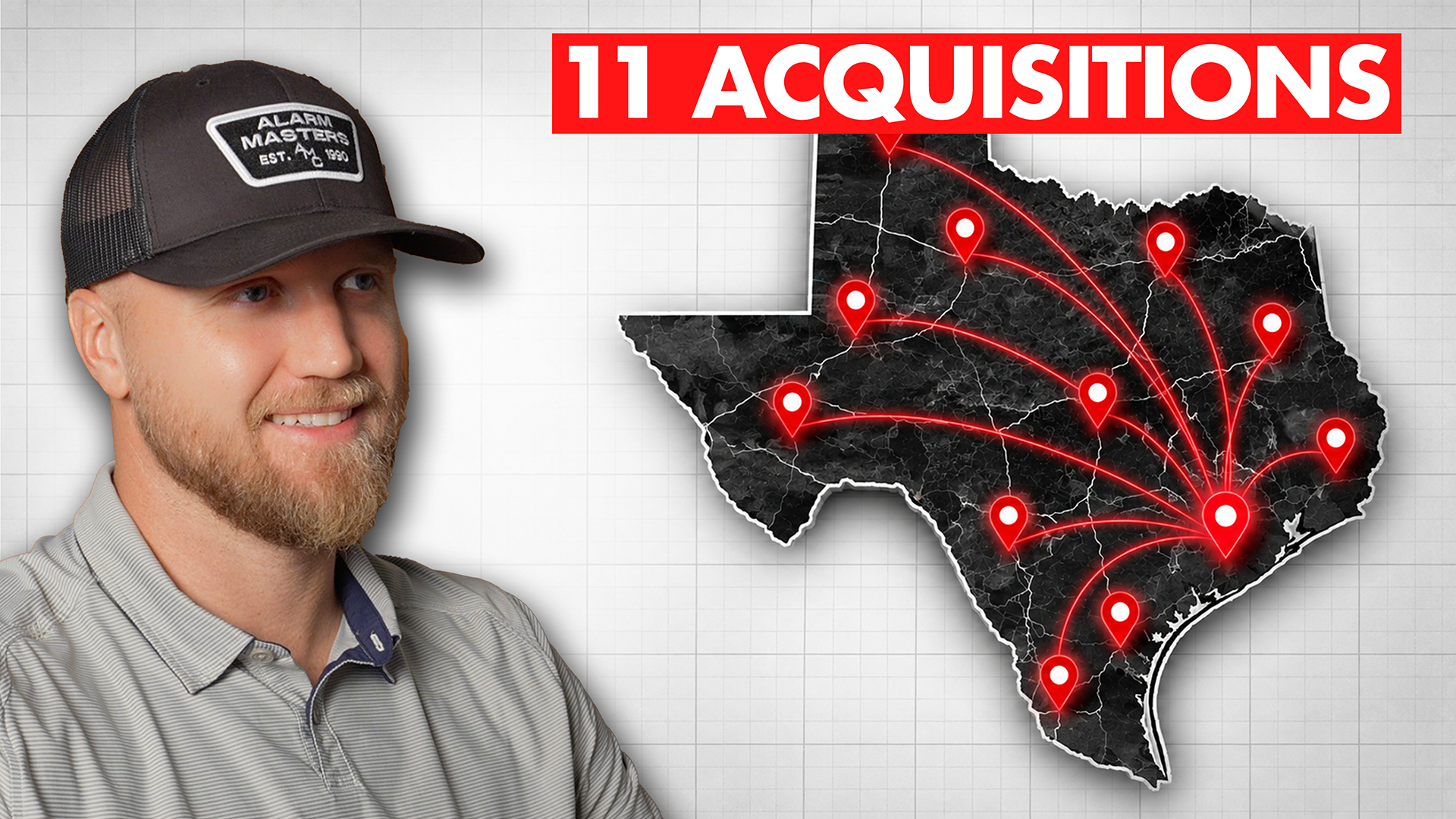


$100K Security Installs: Where the Money Actually Goes
Burglar alarms aren’t the whole story anymore—and they’re definitely not $100K.
In this episode of Entry & Exit, Stephen Olmon and Collin Trimble break down what actually makes up a six-figure security installation—and why the real money is in multi-scope projects.
From cameras and access control to fire and intrusion, they walk through how modern security stacks are built, sold, and scaled—and why bundling multiple systems is the key to bigger deals and long-term revenue.
They also unpack real-world project economics, margins, and what separates a $20K job from a $150K+ install.
In this episode:
- What a $100K security project actually includes
- The “big four”: video, access, fire, and intrusion
- Why multi-scope selling drives massive deal size
- How camera systems and specialty hardware boost margins
If you’re in security, HVAC, or home services, this is a tactical breakdown of how to think bigger—and sell smarter.
More Entry & Exit — https://www.entryandexit.co/
🔗 Connect
Owned and Operated
New Episodes Every Wednesday!
Subscribe For More
We're talking fire, video, access, bird, the big four. And we did almost a million dollars of work. And that's all because we sold multiple scopes. And if you aren't, maybe you should pray about it.
It's pretty wild. It just depends on the customer's appetite for risk. Because it feels good to go do a half a million dollar project, but there's differences, right? There's levels of pain, there's blink, there's complexity. And so when we think about these size deals, bigger is not always better. The 150k is a great sweet spot.
We do a lot of projects there.
Uh I like five million uh personally, but that's just that's just me. That's I don't know. That's just me. Yeah. Really into that.
Welcome to Entry and Exit. My name's Steven Olman, and I also have Colin Trimble with me. And today we're going to be talking about what is a $100,000 security installation. Where does it all go? Where'd the money go?
Where'd the money go? It is funny talking to folks, um, especially some of our residential friends and some of our friends that are um, you know, in other industries, so in, you know, plumbing or HVAC or whatever, and they're like, dang, you you guys did a quarter million dollar install. Like, what the heck? You know, I think if you're in this industry, you obviously have peers that are doing uh over 100K installs. Probably most of them are ground up. We don't really do ground up. I mean, we will for existing customers, but we're mostly focused on retrofit. And so we're gonna use that as an example. We do get a lot of customers, a lot of our peers say, wow, y'all are doing a hundred K install that's retrofit, that's not ground up. And the answer is yes, um, we do. And I
think one general rule of thumb here is like if it's 100K, it's likely gonna be multiple scopes of work. So we're talking fire, video, access, berg, the big four. Sometimes PA is thrown in their public address. And I think that's really one thing that's important to keep in mind is we're not just talking about a hundred thousand dollar burglar alarm system. I don't know if we've ever done a hundred K burglar alarm system. I need to go back and look. Yeah. I think we've done we've done 100K fire alarm, we've done half a million dollar fire alarm jobs. Um, but I I really want to highlight um a particular job. I won't give away the customer name, but the the it's a university here in Houston, and um it was a complete system overhaul. So we did um their uh originally it started with their video and then their access control, and then actually their units, like their dorm room access control, and then now we're having conversations about fire alarm. Um, and so you know, that is the installation portion, but there's also the software element, right? Like we're talking uh subscriptions, RMR, that are coming off of those as well. Um and this was not, again, this was not just a camera system. This was new cameras, new cabling. This is a new recorder, there's a software subscriptions, there was access control, readers, credentials. Um, we had residential door locks. Um, we're looking at doing the fire, so we're gonna have you know, smoke detectors, siren strobes, the notification circuit, and and we did almost a million dollars of work. Um, and and that's all because we sold multiple scopes. And it happened sometimes. We get bigger projects that all happen at the same time, and sometimes they happen um over the course of a month or a year or several months or a year, um, as we you know grow with the customer.
Yeah. Um, it's a good point. Not everyone listening is uh selling multi-scope, so some people specialize, right? Focus on access control, focus on fire, whatever it may be. Um that was a decision we made strategically early on that we were going to really try to push the envelope on that and really try to be fully multi-scope so that we could execute on larger projects and be able to say yes. Um, so part of that is just the intentionality of being multi-scope. And if you aren't, maybe you should pray about
it.
Yeah, I think when you're selling a solution, so like if you get we I always tell my sales guys this sell for the future. Um, and so a lot of our guys will go in and they'll um get called to do a video job, and the guys will say, Yeah, eventually we'll look at access control and intrusion, but we're not, we're not, we're not this year. And it's like, okay, great, hey, no problem, but we're gonna pretend like you're gonna buy everything right now. And the reason is is that we want to make sure that you are future-proofed so that this one solution is not hamstringing you or causing problems down the road. And we're doing this at no extra charge. Like, you don't have to, like, we're not like we're gonna basically design the system as if it was a comprehensive security solution. And so just to like go through, like, let's just go through an example of break it down of a hundred K solution.
Uh, to start with cameras, usually we do a ton of camera work. Um on a job this size, if it was 100k, we're probably doing somewhere in the neighborhood of 20 to 50 cameras. Um, and you know, we're gonna have different types of cameras, right? So there's indoor cameras and outdoor cameras. We generally sell outdoor cameras exclusively and then put them inside. The cost savings on an indoor camera is not that great. Uh, and then you know, you get specialty cameras, and that's where you make a lot of money is on specialty cameras. So you talk about pan tilt and zoom, which are PTZ cameras, which can be controlled, um, or a 180 camera, which literally uses multiple lenses and stitches it together, or a fisheye camera, which basically gives you like a 360-degree view, like it's a warped image that the uh like the VMS will actually de-warp. So it looks like you're like basically looking down on the entire uh area. It's pretty slick. Those specialty cameras have a lot of margin. Um, and so that really helps a lot. And then you when you start to look at different applications for video, I mean you start to look at things like low light or highlight. So low light would be hey, it's a um, it's a parking lot, and they have you know some street lamps, but it's it's not great. They have cameras that are that are called star light cameras, which the stars and the moon literally give enough light to get a crystal clear image. And then you have highlight, where it's like it's sitting in front of a glass entryway and the sun, when it rises, directly shines out of the camera and it can figure out a way to like adjust the exposure and the aperture so that it can still have a good picture throughout the day. So those types of specialty cameras, not just throwing a standard fixed verifocal, fixed or verifocal uh dome, is you know, gonna help drive up some of the value of that project. I would say we're, you know, on a given camera job, we're ballparking customers a thousand to twelve hundred bucks a camera, roughly fully installed, right? So that includes camera and it's the associated CM VR.
Yeah, and I know we're talking kind of a top line gross number of like what's a hundred thousand dollar install look like, like what might
make that up, but I think we should also just kind of give roughly kind of margin profile for the different things that we're doing, you know, high level just kind of ranges. I know it's it it can it can vary significantly, but just kind of like a ballpark.
Yeah, I think generally speaking, on um 100k jobs, you're not gonna have as much margin as you would on a 20k job. But you know, we're we're generally always trying to keep everything we do at that 50% gross profit. That's really where we're trying to live from across both labor and material. And that's we're really where we're trying to, yeah, blend it. That's so that's where we're really trying to stay. Um cameras, because they're pretty commoditized, can sometimes squeeze you down a little bit so you can get down into the 40%. If um, I mean you you could go a lot lower. There's people that sell them for basically nothing. That's not our um go-to-market strategy, but um, yeah, we we're generally in that 45 to 50 percent gross profit margin. The other big element, I'll say this is big ticket, is access control. And there, the reason access control is so big is a, it's there's a lot involved. So you've got electronic locking. So you've got a you are the lock person. A lot of security companies have locksmiths on staff. So you're doing a full um retrofit of the door, adding an electronic lock in place of the mechanical lock. But then you've got the cabling, the reader, um, you've got the control panels, you've got credentials, whether or not that's a mobile credential or a physical credential. Um, and a lot of times you've got like telephone entry systems that are sort of tangential to that. So that's like you press the button, it calls the receptionist, or like a video entry system. So there's a lot of upsell opportunity and access control. Those are generally high ticket. As an anchor price, we tell customers in general $2,500 to $3,500 a door, just in general. Um, and that's fully installed as a fresh install. And if it's like a maglock and there's permitting or there's some electrified crash bar, it can be $4,000, $4,500 a door. It just depends on the situation. Um, but the access control is great because it's kind of a gift that keeps on giving and video too, to an extent, but you can buy more credentials and you can buy upgraded readers. And it's just it's the system that it's really the only system that your employees are gonna be interacting with the most. That's the one thing that they're gonna be touching, and it's a friction point, right? It's like I gotta get my card out, I gotta scan it. So now, like a lot of access control systems are integrating with the video system or sorry, are merging with video systems because the video system is the access control system now. It's pretty wild. But that's uh that's a big high ticket value.
On a $100,000 project, like how much of that you know, you think kind of zoom out, like hardware versus labor versus software costs? Obviously, uh there's certain scenarios where people will uh pay in advance for monitoring for a year or two years. We see that with like grants and nonprofits at times. Yeah, but what's kind of just the general mix of that, you know, again in this in this theoretical project?
In video, it's generally more equipment costs and less labor and in access control. It just depends. But I generally see a lot more labor costs, especially if we're self-performing, the locking, the door locking. Um, and then the subscriptions are generally higher on video, but again, it depends on what you're doing. So it depends on how many integrations you have. But the video subscriptions are generally higher than the door subscriptions um because it's less data. That's really what it is. Like you're not storing in access control, you're storing a database. That's literally all it is. It's you know, a couple megabytes of data. So um, yeah, we we generally are looking at like, you know, on a typical install for a door, if you're a hundred K job, you're probably doing 10 doors, 15 doors, something like that. Um, you know, you're in the 30, 40, 50k of uh total install price um for that. Got it.
Another thing would either be um access control, sorry, would be alarm or fire alarm. And I don't, I think we've maybe only done a few where we've gotten all four scopes on the job at the exact same time. A lot of times it's either fire alarm or burglar alarm. Right. Usually what we see it's berg with access control and video, so it's all the security scopes. Um, and on the intrusion side, you're really focused on devices. And so that one's a hard one to ball apart because it depends on how many devices they have and how much coverage the individual customer wants. That could be anywhere from very basic, like five to seven K for just a couple door contacts, a few motions, and a keypad, or it could be literally in the 50s to 60s if they want roll-up doors, everything covered with 360 motions, glass breaks. I mean, it it just depends on the customer's appetite for risk. Um, and if they want a lot of sirens and keypads and and all that. And that is a lot more uh material driven and a lot less labor driven. There's a lot less RMR associated with that. It's usually a monitoring subscription and an app, and you know, it's 50 bucks a month for the whole system. Um, and so you could see how very quickly, like if you had a 15k um, you know, you had a 15k intrusion system, you've got, you know, 45k in access control and 45k in video, you could see how very quickly you get to 100k. And a lot of these are grant driven, Steven. Like, I mean, a lot of the jobs we've done, as you know, is like it's been a grant or it's been an influx of um you know capital into the business to where they're like we've got to make these upgrades.
Right. Um so
we'll wrap this up with playing a game, which is yeah, uh big game guy, big game energy. Um we have been growing a lot. Um we're you know doing millions of dollars a year and we talk a lot about sales. Um if you could have your way and it was only ever one type of project, what sizing of project would you love the sales guys, you know, our sales team to sell the most of?
Yeah, that's an interesting question.
Um because it feels good to go do a half a million dollar project, that feels nice.
Yeah.
Um, but there's differences, right? There's levels of pain, there's the length, there's complexity. And so when we think about these size deals, uh I you know, one point is that bigger is not always better. Yeah. So yeah, what would what would you pick?
Yeah, my intuition would be like the 150k is a great sweet spot. We do a lot of projects there. It's big enough to be very meaningful, and the customer is making a very educated decision, and price is important, but it's not the only determining factor. Um when you get below the 7550K mark, price becomes a huge factor for the customer. So you've got to do a lot more value building. Um, and when you get over 150k, you run the risk of like what we call the last the last 10% trap, where it's like exactly you have this, these like remaining punch list items that the customer's like not like it's you're waiting on their electrician, and like, but you you there's something they think they're waiting on you, and it's it just can get a little sticky. 150k just feels like that sweet spot, and like I love that usually comes with a decent amount of RMR. You're gonna that's a big project for them. So if you can knock it out of the park, which our operations team always does, or almost always, we earn a lot of goodwill with the customer. So I love that 150k sweet spot.
Yeah, uh, I like five million uh personally, but that's just that's just me. That's I don't know, it's just me. Yeah, really into that. No doubt. Bigger is better to Steven. Um all right. Well, uh, that was a good breakdown. That was fun. That was uh something a little different for us.
Yeah, absolutely. Yeah, I think it's just giving folks kind of a perspective on what we're working on, and like especially if you're outside the industry, like how does this stack up uh as quickly as it does? And so anyway, if you like this content, we'd love and appreciate a subscription, a like, a comment, some type of engagement. Just show us what's up, tell us what you want to hear more about. We appreciate it. Thanks.
.webp)
.png)