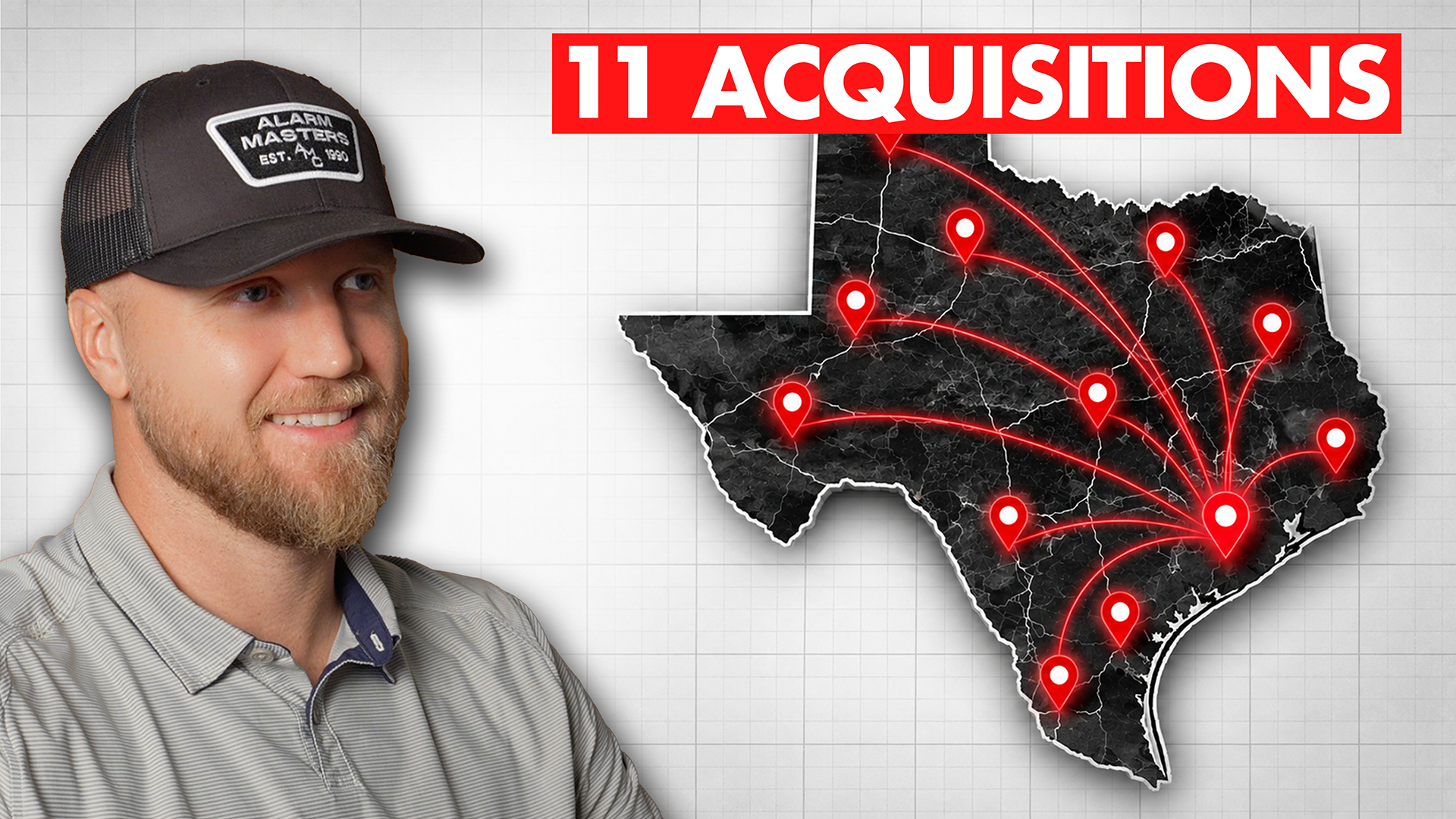


A security business doesn’t just grow one way — it’s built through smart expansion, whether that’s buying, building, or blending both.
In this episode of Entry & Exit, Stephen Olmon and Collin Trimble break down the real tradeoffs between greenfielding a new location and acquiring an existing company in the security industry. From capital requirements to operational complexity, they walk through what actually drives success — and why the best operators don’t treat this as an either/or decision.
They dig into the realities of starting from scratch vs. buying a platform, how to think about risk, and why having a repeatable playbook matters more than the strategy you choose. Plus, they unpack a hybrid approach that combines both tactics to scale faster and smarter.
Inside this episode:
→ Greenfield vs. acquisition — the real pros and cons of each
→ Why having a playbook is the difference between scaling and stalling
→ The hidden risks (and advantages) of starting from scratch
→ How to test a new market before going all-in
→ The hybrid strategy: combining buy + build for maximum optionality
🔗 More Entry & Exit — entryandexit.com
Connect:
Stephen Olmon — http://x.com/stephenolmon
Collin Trimble — https://x.com/TXAlarmGuy
Owned and Operated
New Episodes Every Wednesday!
Subscribe For More
What would you say some kind of classic pros and cons on acquiring? It depends. Typically, you need more money. That likely means you're going to be in some debt, you know, borrow money from your rich uncle, Dave.
I think it's important to distinguish between are you an existing operator trying to open a new location to scale your business, or are you getting into the industry to begin with? If you're going to go greenfield, if you don't have a plan, you should just go acquire. It's nice to be able to start with something and you don't have to start from scratch. I think you should try to greenfield in your own market before you try to greenfield in a separate market so that you're not surprised when you do greenfield into a market where you actually want to spend real dollars.
Welcome to Entry and Exit. My name's Steven Ollman, and I also have Colin Trimble with me here. And today we're talking about greenfielding in the security industry versus a buy and build approach. What do you say, Colin?
This is a tough one. And I think because we're the acquisition guys, yeah, people are gonna assume that we are gonna always say acquisitions. Um and I think the real answer is it depends. It depends. I think it depends, and I think it's also uh I think it they're not mutually exclusive, and we're gonna talk about that strategy here in a second. Yeah. Um but I think let's start first with pros and cons from each, and then we can kind of talk through some of what how we think about things. What do you think about that?
That's
great. And uh, I'm gonna kick us off with some pros and cons related to the buy and build approach. Um typically uh you need more money. Wait, when you say buy and build, you mean acquisition. Yeah. Like we're gonna acquire, you're gonna acquire first. Yeah, just kind of a traditional searcher buy and build idea. You're gonna acquire a platform. Yeah. Um, you're that likely means you're gonna be in some debt to a bank. You might be talking about an SBA loan, equity raise, yeah. You know, borrow money from your rich uncle Dave or whoever, what his name is. Start Eliminate Stand. Yeah. Um, and ideally, you know, some of your own equity, got some skin in the game. Um, but typically, just overall, you're gonna need some money. You're gonna need money coming from multiple places potentially. It is not as simple um as green fielding. Um, and so um that means that you probably have to spend more time preparing. Uh and you also have to weigh the um the risks within that kind of more um kind of capital at risk, whether it's your capital or someone else's capital or the bank's capital. All three of those carry different sorts of risks with them. Um but the fun thing is if you're somebody that's kind of like an improver of things, you're more that person, that skill set, then it's nice to be able to start with something and to improve it. You know, it's existed for 10, 20 years, whatever it may be. And so you don't have to start from scratch. So um, those are a couple things right off the top of my mind. Uh, what would you say some kind of classic pros and cons on acquiring?
Yeah,
I think it's important to distinguish between are you an existing operator trying to open a new location um to scale your business, or are you getting into the industry to begin with? And I'm gonna take the approach as you kind of almost approached it more like if you're a if you're getting into the industry, like buy versus build. I'm gonna think about it more from a frame of reference of if you're an operator um with an existing out, like an existing platform, let's just say in Houston. And you know, maybe you're trying to find a location in, let's say, Dallas. Who knows? I don't I know a couple guys that are kind of in that boat. Um here's what I would say. I think you I think you nailed it. I would say that when you're greenfielding, you obviously have lower risk from a you're likely not taking on, well, I hope you're not taking on debt, you're probably funding it, you know, out of your own capital off your own balance sheet. And so your risk is pretty low, but your chance of success is a little less. And so I would say if you're going to go greenfield, you need to have a playbook that you can repeat in a new market. So it's like if if you acquired your existing business and now you're about to go greenfield, well, you should probably try to run a greenfield play in your own market so you can refine that playbook and then go open it. Because the way you scale that business is going to be different than the way you scale your existing business that's already established with employees and go to market and relationships. And so I would say don't YOLO it, don't don't uh vibe expand your business, you know, vibe could be a way for the people that are maybe not as familiar with your modern vernacular.
What does YOLO mean?
It means a lot of things, it's a way of life, honestly. It's how honestly, it's how you live your freaking life. Okay. Sometimes uh yeah. Uh YOLO, you only live once. Yeah, you only live once. Um, I would say that if you're gonna do it, you should make sure that you're doing it in a way that has a plan. If you don't have a plan, you should just go acquire. There's also a middle ground, which I love. Hot take. I think you can do both at the same time. I think that if you're go ahead.
Yeah, you don't don't jump ahead. Well, I want to you said we should you have you know the listeners should have a plan. We have a plan. We'll get to the we'll get to the hybrid yeah, let's stick to it. Um, so those are some pros and cons. Yeah.
Like let's let's focus a little more on pros and cons of greenfielding. So yeah, the the very first thing that comes to my mind is buying a business, acquiring something is is equal parts good and bad. Yeah. Because if you're greenfielding, and let's just say you're net new, like you don't have an existing operation, we're not greenfielding from Oklahoma City to Tulsa, we're just starting something in Oklahoma City. Right. Um you also aren't dealing with any sort of mess, any sort of culture that you may not like, uh bad processes, bad technology. You get to create everything net new and fresh and kind of within your own DNA from the very beginning. Yeah, that's a very different thing, and there's a lot of uh uh reasons that's pretty attractive.
Yeah. Yeah, I agree. I the thing that I like about Greenfield is you you get a little bit faster to the ideal state of what you want your business to be, and you're not having to worry about cleaning up culture and a and a platform of change, and it's like, no, we're all on the the same platform, we're using the same technology, everything is seamless. Um, and and honestly, I think there's a lot I truly believe that whenever you're greenfielding, it's a little bit of an easier barrier, uh uh it's less barrier to entry because well it is
for sure, but I think it's especially easy because it's like, man, I think a lot of people think when they think greenfield, they think spin up a suite, put a sign on the sign a four-year lease, three-year lease, put a big fancy sign on the front of it, get that Google My Business, spin up a new website, get some trucks, get a technician. Like they're thinking full office. And I would say you should do the lean version of that. So go find a co-working space, but you know, and get a real like office at the co-working space, somewhere where people can go and sit. And if you want to hold meetings, make sure you get a Google My Business, get a new landing page for that specific location. Um, and then I what I would start doing is running ads and doing SEO in that given market to try to increase my local presence. And I would start trying to capture those existing leads. And also, by the way, if you have an existing technician that's willing to travel, I would just stretch that as long as you can. Um, until you have a base of recurring revenue that's really supporting that location, I would really not make any long-term commitments to that office. You agree or disagree with that?
Yeah, I I agree up to a certain point. You you get to a point where you need to start to add in some stability and foundation to a market. Um one thing that I want to call out is it's not like you need no money, and this is true in in any industry, right? This is not just security. Um let's just think like sweaty, you know, home service, commercial service, B2B or B2C. Um there's there's trucks, there's equipment, you're you're going to maybe be able to self-fulfill some work, but very quickly you're gonna need you know, some semblance of a team. Yeah, um, you're gonna need technology. So I don't want to paint the picture that you can do this for, you know, a thousand bucks. You know, like I I want to be realistic here. Yeah. Just maybe just not as much. You don't have to be as well capitalized necessarily, you know, uh when thinking about buying an existing business that's mature versus greenfielding. Um but I I think the uh the other element to think about on the greenfielding side is what you kind of were getting at earlier on the playbook, like um and that's there's multiple different types of playbooks, and we've done different episodes on this. Like yeah, maybe you're like a sales and marketing guy, so that feels comfortable to you, and this is what we experienced some uh on our own. But there's also like an entire operations, you know, kind of playbook too. And so um there are some things that if you if they don't exist, yeah, theoretically you can just kind of figure out as you go, but that's dangerous. So I think if you're gonna greenfield, you have to really think about all parts of the business and have some type of processor playbook that you're you're at least gonna try to execute on. Um, so that's that's a little different than inheriting processes and modifying.
I totally
agree with that. I'll say this. Um, if you're gonna greenfield, here's this is controversial, but I think it's a good idea, and it's something that we've talked about and considered doing. I think you should try to greenfield in your own market before you try to greenfield in a separate market. So you literally could stand up a co-working suite, like for us, if we're in North Houston, we could stand up a co-working suite in South Houston and start doing marketing exclusively in South Houston or even under a new brand name. You know, it could be a different brand name to really test out the playbook to see if we can generate leads and how fast we can generate leads. I think that that is a really good way to learn. So if you're considering greenfielding, I would do a really lean version of it, spend a couple grand a month investing in a market that's maybe a tertiary market outside. So for us, like for example, you could go try to greenfield into Huntsville or Beaumont. Not a huge stretch, uh, but we don't have an active office in those locations. Right. And so you could actually try to start a brand in that office to try to test your playbook on what's working and not working so that you're not surprised when you do greenfield into a market where you actually want to spend real dollars because ultimately you want scalability, right? It's like at a certain point you want to say, I know that if I invest, you know, a dollar, I'm gonna get two or three out, you know. And if you're not able to do that or don't have line of sight to that, then you should keep refining your playbook.
Yeah.
So we've talked about kind of uh both of them, but but let's talk about maybe a more intentional hybrid approach, yeah. Where you're uh and really was kind of our sp one of the things that we have considered as a part of our strategy. And so I think there's two versions of of a hybrid and it's just kind of dependent on where you start. So yeah, you could let's say you're at a W2 job, somebody right now that's dreaming of owning their own business, and you greenfield into uh I'm gonna stick with Oklahoma. Um and let's go Tulsa because it's for my I have family that lives there. It's really nice this time of year. Um and which is basically just like 10 minutes from you in Dallas, right? Yeah, it's super close.
You're basically South Oklahoma.
I'm basically South Oklahoma, yeah. It's so way, hey, you know, we just keep building houses. Um so um you greenfield first, and then you if you get your footing, you could start to acquire accounts locally and so you could run that direction and agreed in ways that is a bit de-risk financially, yeah. Um, in in in one sense. And then the opposite would be more along the lines of what we've done.
Yeah. Yeah, I agree. I think the magic, the magic blend is go Greenfield into a new market in the leanest way possible. Try to look for a block of accounts or another platform while you're doing it, all the while you're building a marketing footprint and a reputation in a given market that's gonna only benefit you, even if you don't use that name brand. Like let's just say you buy something AMC, but then you buy another company, you know, XYZ company, like you can still keep that existing brand, those brand assets. And I would say it's a marketing game. And I would say as long as you are doing something, um, it's gonna be worth your time because uh any amount of work that you do is gonna benefit you on the greenfield. And then if you can find an acquisition down the way and if you want to use that brand, great. If you don't, you want to roll it in underneath your existing brand, that's fine. But optionality, I think, is the key. And I don't think they're mutually exclusive. I think that uh running them in parallel is a good plan. It's something we're working on and something we're trying to do. Uh and you know, one thing a lot of people do is they put up pins, like I think it's a little different than putting up a pin all over. Like we've seen some people that are like they have an office in you know, Detroit, and it's like they have pins all over the United States, but it's like they don't actually have locations there, and they're kind of just ignoring the leads that come in. It's like I don't know if I love that approach, it feels a little misleading and deceptive. Like, I think if you're gonna put a pin in a location, you need to be willing to execute on the work.
Yeah, yeah, that is uh, you know, a bit controversial, but um some people do it. Um last thing um I'll say is you could uh greenfield into a market. Like why do you choose a certain market? And this is really more for a current operator, and this is kind of where we see things. Like you could choose to greenfield into a market because there are no good acquisition targets. Yeah, yeah. And so I can think of a market that we have talked about very specifically, yeah. Um that we already know you know, everyone there. Uh we've we've talked to multiple owners. There's nothing that we're going to buy in that market probably in the next several years. Yeah. So if we want to be there, we kind of have to greenfield into that market.
Agreed. Yeah, I think that I think that's a really strong consideration. So yeah, I think I think if you're taking anything away, it's both are great. I think that don't greenfield if you don't have a plan, but it's easy to start a plan. It's just like anything else, it just takes time and reps on a little bit of cash and it's like, hey, uh, you should try to do both and learn how to do both. We have not yet greenfielded into a new location yet, but we have done it in other lives. And um, I would just say that that's kind of our understanding of it. And more importantly, Steven.
Greenfield your way over to the comments. Okay, just just kind of greenfield your way over, just peruse around. Yeah, and just oopsie. Maybe you you happen to leave a five star review and yeah, greenfield your way to the subscribe button if you would. All the way to the newsletter and just up and down, left and right, greenfield everywhere.
Yeah. Well, we appreciate you listening and putting up with Steven for this episode. Hope everyone's having a great week.
.webp)
.png)