

The best sales strategy might not come from your sales team. It might come from your service department.
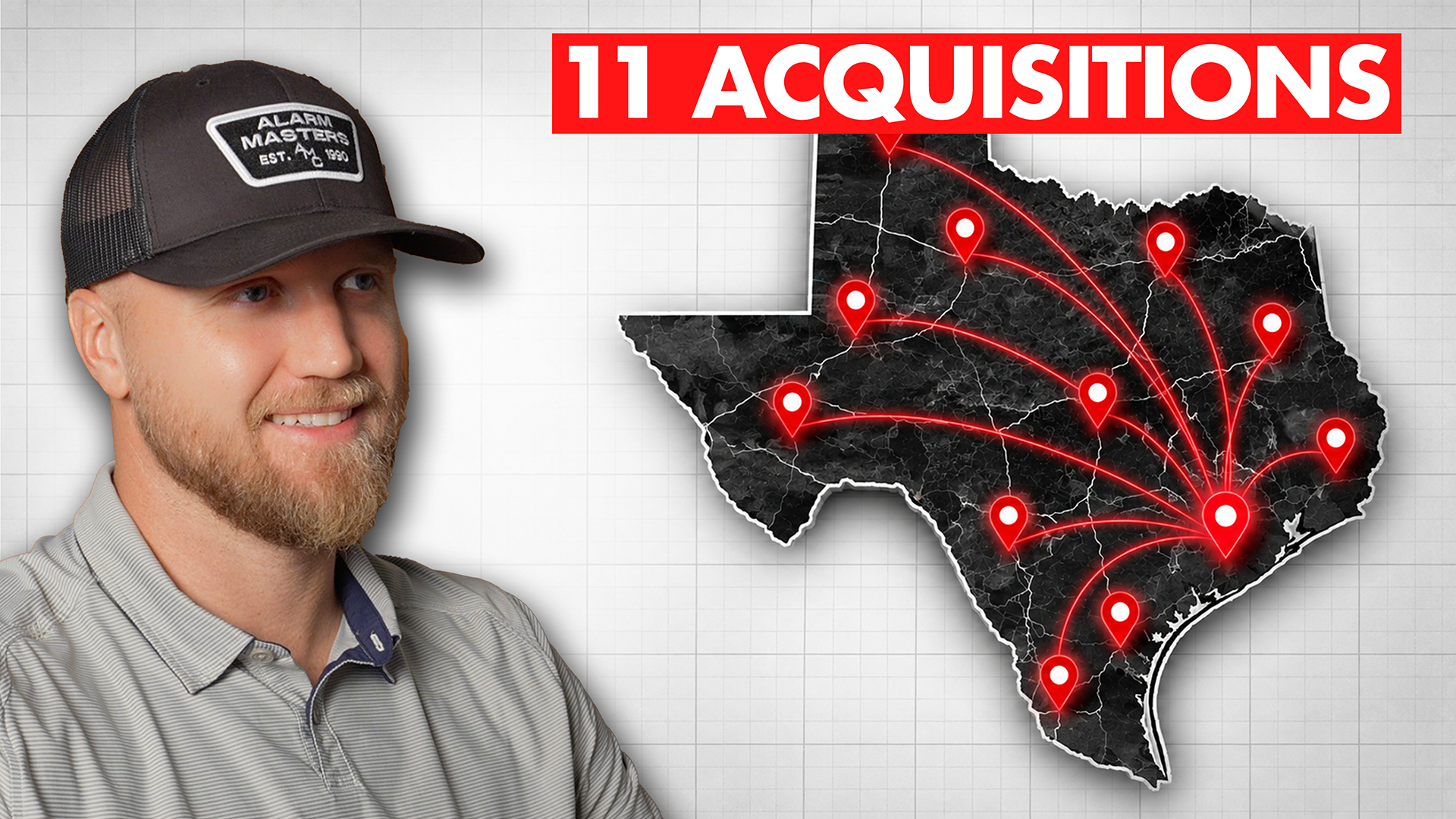
In this episode of Entry & Exit, Stephen Olmon and Collin Trimble break down the playbook Alarm Masters uses to turn routine service calls into major commercial projects. They explain why leading with exceptional service builds trust faster than a sales pitch, how their teams work together to create new opportunities, and what it takes operationally to make the strategy successful.
In this episode:
→ Why service is Alarm Masters' biggest sales advantage
→ The playbook for turning service calls into major projects
→ Why the first dollar from a customer is the hardest to earn
→ Building enough service capacity to support growth
→ How sales and service teams work together to create opportunities
→ Using service history to uncover replacement projects
→ Why face-to-face prospecting still works in an AI-driven world
→ The operational mistakes that can derail this strategy
Connect:
Stephen Olmon — https://x.com/stephenolmon
Collin Trimble — https://x.com/TXAlarmGuy
Owned and Operated
New Episodes Every Wednesday!
Subscribe For More
Where we shine, it's our service department. We would love the opportunity to just do a single service call for y'all. If you think that we're great, we'd love the opportunity to do bigger projects with you. But we believe it starts with our service. I I'm so passionate about it because I've seen it work.
Now our sales team knows that that's like a proven playbook that works because now they're winning chunky projects.
Take a hard assessment if your service team sucks. If they're use that I said the A double S word, bro. Whoa. I said it. I'm a bad boy.
My my kids listen to these.
Oh shoot. Alright, well.
Welcome
to Entry and Exit. My name is Steven Ullman, and I also have Colin Trimble with me, who is my business partner and my very handsome co-host. If you're not watching, just trust me. Nice jawline, nice beard, pretty eyes. And uh today we're talking about we're talking about some strategic things related to service.
Yeah, so we're gonna talk about the interplay between sales and service. Um, this is again something that's really kind of near and dear to our hearts in this exact moment. Um, our two single biggest sources of leads is coffee drops, which we have talked about a tremendous amount. Um, which um we've kind of like used coffee drop as basically a way to say any prospect, a catch-all for any prospecting appointment to any customer, but really a coffee drop is uh a coffee drop to an existing customer that you're dropping in on. So that's one big source of lead. The other big source is our service department, and it's really interesting. So this is a really interesting um go-to-market strategy for alarm masters. So this is some of our secret sauce. So we we don't we don't keep secrets here, like we uh no, we put it all out because we're not afraid. If you copy us, great. Um maybe you can tell us how we
can improve. But one of the ways that we um create value, our value prop, we really have uh we have three. The the biggest one that we talk about is our service department's gonna win. Uh, we invest a lot in our service department. We're gonna have the most white glove experience, the most dialed, the best technicians giving the best experience very quickly at a fair price. And our service department is going to be a tool for us. It happens all the time that we get calls from people saying, I've got a broken fire alarm system, I've been trying to get a hold of XYZ company, they won't come out. Can you come out and fix this thing for us? All the time. Too many people say no, or I'll see you in two weeks, or let me charge you $300 an hour to get you off my plate. And that is not the approach. When you get one dollar from a customer, you are almost certainly going to get another dollar. The first dollar is the hardest. The first dollar is always the hardest.
And so here is our sales play. And I think you should try this. For new logos, and this is all about new logos, meaning these are uh customers that we don't do business with today. We call those a new logo. For new logos, what we will do is we will find leads, which we've talked about in other podcast episodes about finding very strategic lead source information. So you should go back and listen to some of the AI episodes on sales because we talk a lot about that. Um, when we get information, so let's just we're really targeting uh uh senior living right now, um, and independent living, that whole thing. And so once we get the contact information, we get the location, and it fits kind of our buy box or whatever, our ideal client profile. Yeah, we will go out there and we do not do this. And this is what all of our competitors are doing, or the the most of them here locally, is let me offer you if they're showing up on site to prospect, uh, what they're offering is let me do a free security audit. Um, I don't think that that works. I don't know how many people have done how many security audits out there have converted to big pipe that have started as a prospecting appointment. I'm sure there are some. Uh, I I fundamentally don't think that that's going to be the way to move the needle. But here's what we do. Okay, this is this is it. We we should end this episode at five minutes. We're not going to, but we should because um what we do is we send a sales guy out there with his card with a cut sheet that's vertical specific. So we have a cut sheet, very fancy, gloss, nice looking, high color, high contrast pictures of this is senior living. We go have a point of view and we walk in. So we've got some information from our little AI SDR guy that's developing the lead, getting us the contact information, telling us about the facility, how many beds does it have, when was it opened, who owns it, who's the property management group, what fire citations they've had in the past, how many times to give us a little point of view. The salesperson reads the point of view, takes the stuff in with his card, shakes the hand of the executive director, hands it to them, and says, Hey, obviously, y'all have been around for a long time. You probably have some aged equipment. Where we shine is our service department. We would love the opportunity to just do a single service call for y'all. If you think that we're great, we'd love the opportunity to do bigger projects with you. But we believe it starts with our service. That's the best way to prove our worth. Here's my business card. I'm gonna write one free trip charge onto this card. The next service call you have, you call them and tell them my name and tell them you got a free trip charge waived, and call us, and we will be out there same day or next day, depending on the situation, and we will get it resolved. I cannot tell you how many times that we have run that play and the customer, we go out there, they out two weeks later, fire alarm issue, find out that the fire alarm is broken and needs to be replaced, and that lead goes back into the lap of the salesperson. And that whole sequence, the service call, which is not, you know, trip charges weight, a couple hundred bucks in labor, whatever, that was basically break-even to source the lead. Yeah, so like our acquisition cost has been completely covered. The fuel for the sales guy to get down there, all you know, all that is covered by the service call. And then we've got the project for the fire alarm. And so this is where we could end the episode right now is if you will do that, you will win more deals. If you can figure out a play that starts with you getting service, you will win more deals. I I'm so passionate about it because I've seen it work.
You uh so selling through service, and there's something very specific that's required, which we've also talked about in the past. In order to sell through service, that means one, you have to have purpose built a service department, you have to have a um you have to have enough bandwidth to service that type of machine. And so sometimes that can feel like overstaffing um when you want to be able to say, hey, we'll see you tomorrow, which is our slogan, you know, don't steal, fight you. And then two is you also have to have the God bless you, thank you. Yeah. Uh you have to have uh that's a great song, by the way. Yeah, it is. Um you you interrupted me, your uh train of thought. Here we go. You have to have enough uh field sales people to support this, right? Like if you have one sales guy and you're actually pretty active and you want to run this play, like now we're probably talking about a second or the next sales hire, probably. If you already feel like your current sales team is at bandwidth to run this playbook, you have to have availability. And at first, that person may feel like it's not the most efficient thing, but then they see it work and then they get excited about it. And so now our sales team knows that that's like a proven playbook that works because now they're winning chunky projects with real commission dollars behind them because they sold through service, and it starts to kind of feel like cheating. Um, and I think it's because it's human nature, so you don't have to overcommit. I get something for free. You help me faster than I'm normally helped. You are local, and now I trust you. I'm you know, breaking news. Person who develops trust wants to trust the person more and give them more things to do. Yeah, mind blow. So um I I think it is kind of obvious, but the hard part of actually gleaning or getting the benefit from this approach is being set up for it.
That's right. That's exactly right. You've got to have the foundation to be able to run the play. So if you're if your service take a hard assessment, if your service team sucks, if they're ass, then don't use that. I said the AAAS word, bro. Whoa. I said it. I'm a bad boy. My my kids listen to these. Oh shoot. All right. Well, nah, I mean sometimes. Yeah.
They learned a new word, vocabulary. Yeah.
Um you've got if if they're bad, you've got to fix that problem first. Um and you obviously like need to have folks that you can rely
on. Another thing you can do, but we've talked about this before, but this is sort of like a uh a pilot version of this, is have your salespeople go through all your service tickets and look for a pattern. You can use AI too. That's uh you know, a pro move, but like just start with looking at tickets. Like, do you see the same customer having five tickets in 90 days over the same fire system? I bet they're pretty tired of spending money on those. I can't tell you, every time we've had a new logo come endbound, they have said, we have spent almost as much as we think we're gonna spend on this fire alarm system in service calls in the last year. Yep. They're sick of it. And it's not real, I mean, if they haven't, like if I'm doing a $380,000 fire alarm system, they didn't spend $380,000, but they probably spent $50,000, $75,000. And so to them, they're like, that's insane. Why am I throwing good money at bad? And it is, it's a valid, it's a valid way to think about things. So I think that if the first thing is take a hard look at your service team. The second thing is just go back through your own tickets and look for this yourself, and that's a great place to go do a coffee drop. Um, none of your competitors or peers will show up, they will not do cold drop-ins. They think that that's SMB, resi, door knocking. It's not that. If it's, hey, I'm just here to introduce myself as a resource, I'm your local fire alarm company. We've got it's even better if your sales guy could know that there's a few people in the area. So, what our guys do is they backfill it with other customers that we're going to see in the area. Hey, I was just at John's down the street, and we just helped him out with XYZ. He's a customer. Go talk to him, go walk into his whatever office. I'm sure he'd be happy to advocate for us. I just wanted to stop in. I've seen y'all building here a million times. I wanted to stop in and introduce myself. There's nothing weird about that, there's nothing awkward about that. You're not selling on the first walk-in. No, no selling allowed. You're driving value and you're introducing yourself and you're networking is what you're doing.
Yeah, and I mean, how many times have we heard or our team has heard, oh, I'm so glad you came. Like, I I know that uh, you know, we worked this other company, but like I've never met someone from that company. I know that they monitor us. Or we've even heard that from our own customers. Like, oh, like this is nice to put a face to a name because I've worked here for four years and no one's ever come here, you know. So that's whether it's cold, drop-in, or coffee drop current customers, same principle. You know, it's the we keep talking about like an age of AI and software and automate, automate, like face-to-face, in-person, human-on-human wins. And so uh it's just kind of an extension of that playbook, and we've been doing it for a couple of years and it works.
This is your best sales play. Use your existing team to go and drive value. This is your biggest sales play. Go get the first dollar. And if you want to hear more about sales plays, leave us a comment. Subscribe, you know? Let us know.
Comment big sales boys in the comments. Big sales boys. Yeah, that's right. Big sales boys.
We hope you have a great week.
Thanks.

.webp)
.png)