

The traditional alarm company is changing fast.
In this episode of Entry & Exit, Stephen Olmon and Collin Trimble explain why independent alarm companies are facing increasing pressure from industry consolidation, evolving customer expectations, and the shift toward video and access control. They discuss why recurring monitoring revenue is no longer enough, how the industry's most successful companies are adapting, and what security businesses need to do to stay competitive.
They also explore the rise of modern security integrators, the operational changes required to scale, and why acquisitions are creating one of the biggest growth opportunities in the industry.
If you own or operate a security company, this episode is a practical look at where the industry is heading,and how to prepare for what's next.
In this episode:
→ Why independent alarm companies are being consolidated
→ How video and access control are replacing the traditional alarm model
→ The difference between an alarm company and a security integrator
→ Why recurring monitoring revenue is no longer enough
→ Building a scalable service and sales strategy
→ Using acquisitions to accelerate growth
→ How to cross-sell your existing customer base
→ Why the age of your customer base could become a major risk
→ The operational changes security companies need to make to survive the next decade
Connect:
Stephen Olmon — https://x.com/stephenolmon
Collin Trimble — https://x.com/TXAlarmGuy
Independent alarm companies in the next five years are going to significantly struggle. It's gonna be tough to let, as the kids say. I don't know if the kids say that.
The kids, I think, don't say that and haven't since 1972. The traditional alarm, independent alarm businesses, they're getting absorbed. They're getting consolidated and they're getting acquired by larger roll-ups and other larger regional players.
We're seeing a lot that are shrinking.
The way we see alarms now are not gonna be the same in 10 years. And it's moving to a video first world, an access control world.
Welcome back to entry and exit. And actually, if it's your first time, welcome for the first time. Uh, I just want to speak to you all right now, uh, but I'm glad you're here. And uh, I'm Steven. I also have Colin here with me, and we'd like to talk about security and like alarms and technology and growing our business, and hopefully it's helpful to people just like you. Today, on this episode, we are talking about the reality that independent alarm companies in the next five years are going to significantly struggle. Uh, I almost, you know, we we would say, will they all be dead in five years from now? No, but that's not a good strategy in the next five years. Yep. And we're gonna tell you why. So the funny thing is when we kind of built our thesis about alarm masters, the very thing that we're gonna tell you today is is probably a a a bad idea, bad strategy, a losing angle is what our thesis was basically four or five years ago. Um and so we thought like local alarm companies sell on the local narrative. Um there's a there's a lot of good things about that, and it's still somewhat relevant today, but today is very different than five years from now, and we're seeing some things happening in the industry that we think kind of uh signal that four or five years from now it's gonna be um it's gonna be tough sledding, as the kids say.
I don't know if the kids say that but I think don't say that and have it since 1972, but yeah. Oh
I I I want to distinguish, we've done this in the past. I want to distinguish between an integrator and an alarm business. Those lines are very blurry. There's a lot of hybrids, we are a hybrid. Um what has traditionally been known as an alarm company is a company that literally just basically sells alarms and they do some light security work outside of the alarms. So that would be video access control, a little bit of access control, a decent amount of video, fire alarm maybe, but mostly servicing and monitoring. They're also not typically an alarm company doing massive new installs. They're not doing multi-scope projects, generally speaking, and they're very focused on recurring revenue and they're really focused on service. Um, and so they have a little bit of project work, but they're really focused on recurring revenue and service. And that is kind of a telltale of a classic alarm business. An integrator is not really even doing alarms, they're doing security, they're sorry, they're doing uh access control, they're doing video, they're doing maybe some fire alarm, maybe, and they're doing some building automation, they're maybe doing a little bit of alarm in terms of they're integrating the software with the other ones, sure, with the other platforms, and they're giving you kind of a platform. And so that's really what a classic, a lot of ground up construction companies are doing that multiple scopes. So an integrator would be I take all of the scopes and I am all the scopes for security, but they're not doing a lot of like uh retrofits or upgrades. And then there's this like blend in between those. So there's like the new construction guys and then the guys that are like uh you know doing light small projects, and that's that's really where Alarm Masters falls. We do ground up construction, but not really through general contractors, sometimes, but rarely. And we do a tremendous amount of service work, but I will do a $180 service call all day long, and I'm also very hungry for RMR, and we're also doing million-dollar projects, so we kind of fit that whole spectrum.
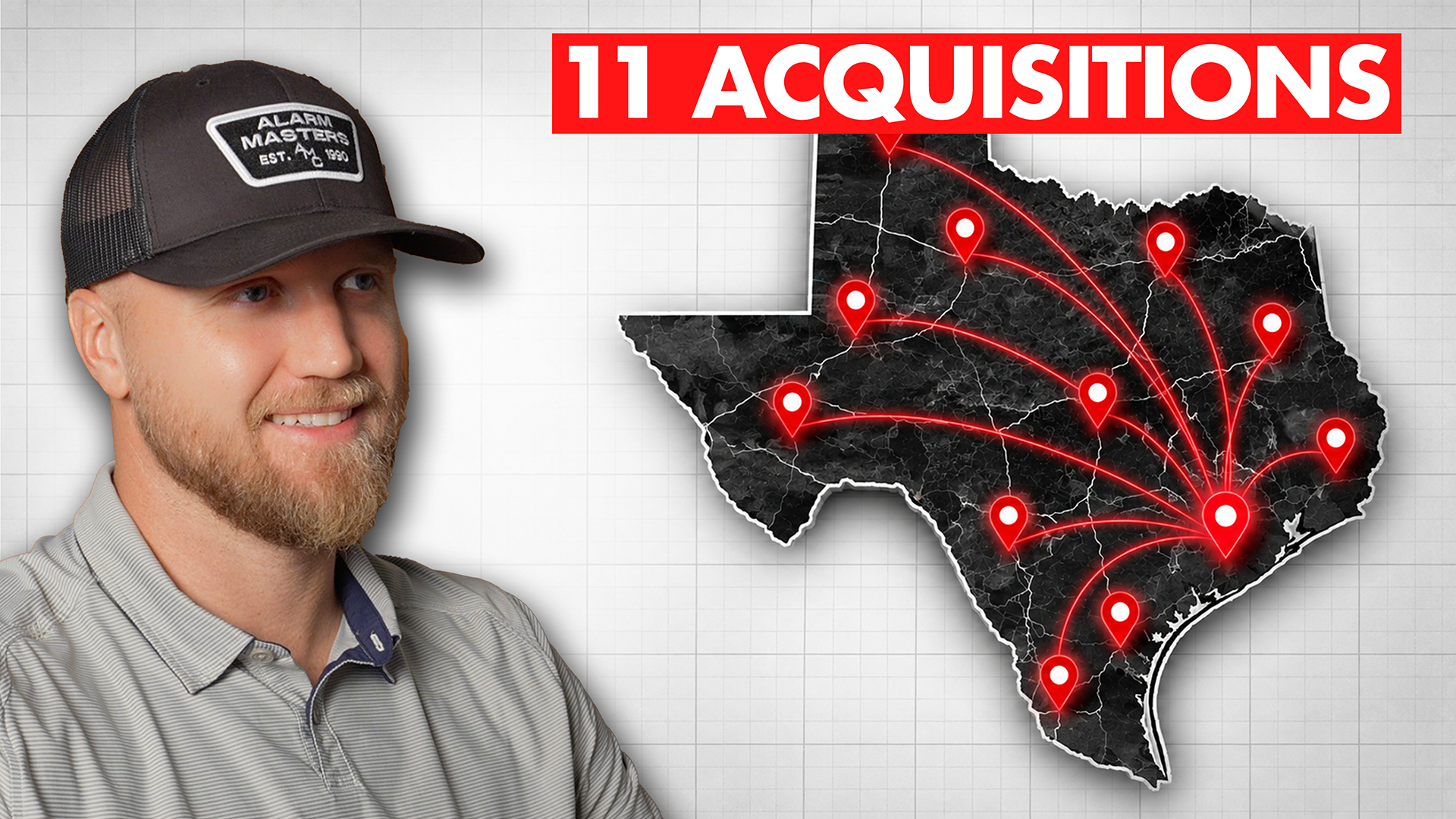
And so I think what we are seeing uh we have done nine acquisitions in three years, and they have all been independent alarm businesses. And what we are seeing is um the traditional alarm, independent alarm businesses are they're getting absorbed, they're getting consolidated, and they're getting um uh acquired by larger roll-ups and other larger regional players. And I think we should talk about why that is and kind of the future of where things are going, um, just because I think it's an interesting topic.
I would also say before we dive into that, that um those types of traditional alarm companies, if they are not being acquired, we're seeing a lot that are shrinking. Yeah. Um, and so you know, it's just uh competition is increasing.
Yeah, I want to start with this. Why how did this start? Well, this started because um alarms have RMR and everyone likes RMR, and so a ton of people jumped into the pool to sell alarms, especially high volume companies. Think vivid, think uh what ADT has become, to start selling high volume alarms, and so they price compressed people, and they were just going out and buying blocks of accounts to get as much RMR as they possibly could, and that's basically all they did was just RMR that was like 90% of their revenue, and that's that's what these companies did. And so what that did to the independent alarm integrators is they couldn't keep up because they didn't have the same business model, and so their margins were compressed. So they started just really selling on service, and so that's really where they're like, Hey, I can be out there tomorrow. I know you can't get a hold of ADT, but we'll be out there tomorrow. We'll come fix that panel for you. Um, and I think what else started happening is integrators started selling alarms because, like, hey, I can sell an alarm. Like, I'm gonna do a major uh video project. Sure, I'll give you the monitoring for half off. Like, I don't care. I want your video, I want your access control. And so they were undercutting the independent alarm guys. Um, but that RMR is super valuable, and it's a lot of customers that have been around for years because they call somebody and they get they get to talk to somebody. They don't go through a phone tree, they have a conversation. Um, and the other thing that's that's really the new iteration of kind of what's killing the classic alarm companies is alarms in general are gonna go away. Like uh the way we see alarms now are not gonna be the same in 10 years. Um, and it's moving to a video first world and access control world. Access control manufacturers are selling uh alarm monitoring now, which is just wild. Um it is, and that's that is the new reality, right? So that is the new reality for um for these customers, and so anyway, yeah, I think I I think that you're gonna see this more often. I think we're gonna see a lot more people um that are alarmed. I don't think we're gonna see new alarm companies, I think we're gonna see new integrators and new security companies, which is kind of the new hybrid.
Yep, I I I totally agree. And um the kind of further and going further down the path of consolidation, what happens when you're the local alarm company, kind of traditional alarm company, and you're in a market like DFW or Houston, you know, and you've got big nationals that have come in, they've bought up some some quality uh local brands there, or maybe it's regional consolidation, and they've got significant scale. Like we've talked about AI and gross margins on different podcasts, things like that. And just from a sheer amount of manpower and scale and technology, kind of uh technology enabled service delivery, uh, everything across the board, like I think over the next four to five years, it's going to be harder and harder and harder to compete on top of, like you said, the kind of shifting nature of the market's demands, anyways, and that we're going it video first. Yeah. Maybe we already are technically video first at this point, or maybe we're 12 months away from it from you know, just like on average, what is someone actually buying? Yeah. Um, there's all this legacy stuff out in the wild, but those traditional alarm companies, if they aren't adapting and changing, uh I just even if they are, I still think it's gonna be really difficult. But if they're just operating like they used to, like it's 2008, yeah, that's maybe a bad year to pick 2011. Um holy smokes. Um, yeah, we'll go 2011. Yeah, like I don't I don't think many of them are gonna stand the test of time. Yeah, they would need to be quite large already to continue to operate like that into the 2030s.
Yeah,
I think that uh growth and scale is your greatest protection. Um and I do think if you're a classic alarm integrator or sorry, classic alarm company, you're listening to this right now and you're like, Well, that's not true, like that's not gonna be me, or like, how do I get out of this trap or whatever? It's like, hey, the way you get out of the trap is you become really educated, you become excellent operationally. You have a scalable sales and growth strategy, and you become really competent on other security scopes. Like your team should all all security techs should know how to install alarms and service them and video and access control. Uh, and you should also get and one very classic sign of a classic alarm integrator is like I can do everything. Like I can touch and work on all the things, which you don't become a master of, a few things. And so I think you need to get like more specific on your at least your project team on like here's the things we're gonna sell. You need to start selling more projects, more multiple scopes. And and but here's the thing that I think they you have an advantage on speaking to the alarm company, is you've got great service and you should double down on that. You should triple down on that. You should be trying to increase your service month over month. And that is something that's really important. You have a probably a great block of RMR. You should raise your prices, you should go upsell them and cross-sell them on other services. And if you can do that, you'll be around. And if speaking to the folks that are not an alarm integrator, maybe they're a security business like us, or maybe they're more like ground up, they're construction. There's a lot of alarm companies that are the guys and the gals that are running them are retiring. And it is a great opportunity to acquire those businesses and get great technicians and employees and get a great block of accounts that you can go cross-sell on. And that is the core of our growth strategy. And I think that if you are sitting in the security industry right now, you should be meeting with these local alarm companies all day, every day to build a relationship and show them about your secret sauce because it would be much better for them to sell to you, who values the customer experience, than to a national who may not care as much.
Yeah.
The last thing I'll say, this is not true of all traditional alarm companies, but we have seen this a lot. And it's kind of down in the weeds, but I actually think that it's gonna bubble up and be a problem for a lot of them is what's the average age of your customer? Yeah, Mr. Traditional Alarm Company. Yeah, you probably don't have that in a spreadsheet, but I bet instinctually you know, and like we've served a lot of these same accounts for 25 years. Well, that's awesome. Your business may die due to competitive forces and industry shifts, but also like your customer base may start to churn, not due to your poor execution, but because they're not around anymore. And so, yeah, if you also have like an older aged customer base, you really need to be thinking proactively about how to build away from that um and diversify your revenue from your current book because it's gonna it's real it's gonna slap you in the face in a few years. And this is actually really very much akin to kind of an old school wealth manager, and this happens like where guys have a book and then the kids don't think that guy's as relevant, and they go, you know, move the money to some other kind of 40-something guy that has a lot more energy, they feel, you know. And so, you know, what's the average age of your book? Like, and I think that also is gonna play into the staying power of traditional alarm companies. But in general, like I just don't think that model is gonna work long term.
Yeah, I agree. Oh, I think it's great. Um, Steven, if if folks uh are interested in learning more about this topic or they want to engage or help us out, like what would they do to do that?
Well, first of all, they can comment alarm companies are dying. Um that's I'm kidding. Well, maybe. Um uh but uh they can they can subscribe, they can follow, they can like, uh, they can comment other things that maybe not are not as dark. Yeah. Um subscribe to our newsletter. Yeah. Um send it to a friend from college you haven't talked to in a decade. Oh, that's a good idea. Whatever you think. Yeah. Yeah. Yeah.
Life life's open to you. We appreciate you listening. Have a great week.
.webp)
.png)