

Going from $2 million to $12 million didn’t come from one big breakthrough.
In this episode of Entry & Exit, Stephen Olmon and Collin Trimble zoom out on the last three and a half years of growing Alarm Masters and break down the biggest drivers behind that growth.
They explain why they stopped trying to hire “okay” people cheaply and started investing heavily in great people, why you need to hire ahead of the growth you want, and how the right technology and infrastructure can determine whether your business is actually ready to scale.
Stephen and Collin also break down how they built a scalable sales team using data, specialized roles, international talent, and technology, plus why acquisitions have become a critical part of their strategy for reaching the next stage of growth.
In this episode:
→ How Alarm Masters grew from $2M to $12M
→ Why great people are worth paying more for
→ Hiring ahead of the growth you want
→ Building a tech stack that can scale with the business
→ Using data to build a scalable sales team
→ Why sales reps shouldn’t be doing everything themselves
→ Using international talent and technology to increase production
→ How acquisitions accelerated Alarm Masters’ growth
Connect:
Stephen Olmon — https://x.com/stephenolmon
Collin Trimble — https://x.com/TXAlarmGuy
Owned and Operated
New Episodes Every Wednesday!
Subscribe For More
Kind of zooming out. We tried early on to hire okay people at really cheap rates. Find the best, smartest, brightest, hardest working people you can. And you kind of have to hire ahead of the growth that you want. We made a hire recently, and just it is so evident to me that he is smarter than me. It's buy once, cry once. Crap in, crap out.
Also business owners know where they want to go, or at least they have a really good concept. They just don't know where they are today. They're like, yeah, I'm a two and a half million dollar business and I want to be 10.
You can't even really do that well if you don't have the supporting team and infrastructure to go plop that on top of. Welcome to entry and exit. My name is Steven Ullman, and I also have my counterpart, business partner, work wife, uh, you could say, and co-host Colin Trimble with me, looking beautiful as ever. And uh, if you're just listening, you can take my word for it. Or, you know, go look at his LinkedIn. Link oh, his LinkedIn. His link his his LinkedIn. Take a peek. Um so today we are talking about kind of zooming out and looking at what we have accomplished so far. And um really the the journey has been going from kind of two to twelve million, and we'll talk about more specifics um in a little bit. But you know, how do we do it? What were the the main drivers of the progress we've made in three and a half years? And you know, maybe some things that other people can follow and uh take our lead on that's worked out and it has not been perfect. We are not perfect operators, we've made lots of mistakes, lots of things I wish we could go back on. Actually, I think things I wish we could have prioritized more heavily.
You made more mistakes than me though, probably, yeah.
Let's be honest, uh for sure.
Um so uh right off the top, going from two to twelve, yep, if you could only pick one thing, what is the big kahuna? What is like the number one difference maker you think in our success over the last three and a half years?
I would say it's more of a concept than like a specific lever that we pulled. And the concept is that we spent a lot of money on a lot of really great people. And we tried early on to hire okay people at really cheap rates, and we have flipped to hiring great people at really expensive rates. And I think fundamentally, one of the things that I hear in this business all the time is about owners of businesses, even guys that I know that are my age, that do not want to spend money to invest in their business. And it's this funny inverse. You see, like venture-backed startups where they basically run at negative profit for decade, longer, years, and then they finally get to some scale, and then they are now they turn the profit levers on, and then they stop investing in different things and they're managing more for earnings. And what we see a lot of operators say is I want to manage for profit, but I want my goals are all growth goals. And it's like, hey, you're not gonna come up with something smarter and you're not gonna throw more of your time at solving a growth problem. You have to invest dollars. And for us, that means that we don't go all the way down, so we're not zero dollars, we're making a ton of profit, we're doing great, but we've also could be making more profit if we invested less dollars in great people, or if we didn't spend as much money on technology. Um, and so I think fundamentally, if you had me pick one concept, it would just be that like we've invested in great people, and it's kind of a cliched thing to hear. And people, I hear this all the time, like on podcasts, they talk about their people, and it almost seemed like when I would used to listen to business podcasts, I'd be like, that's kind of like self-serving, you're trying to be humble. And I'm really not like fundamentally, you when you get to a certain size, you just can't do it all yourself. And so you need really, really great people, and you kind of have to hire ahead of the growth that you want.
Yep.
So if you want to be a $10 million business and you're set up squeaking by as a $3 million business with the people that really are at a $2 million size, you're never gonna get to 10. You need to kind of balance this higher grow, higher grow. And you kind of always have to hire just a little bit ahead. And you kind of have to know where your growth is and like when is cash coming in and what kind of what do you have in your pipeline, etc. And so anyway, I just I think that's the core concept is like hire great people. I think if you zoom even farther out, it's just like invest in your business wisely, manage for growth, manage for earnings. Like you doesn't mean you can't take money out of your business. It just means that you, if you really want to grow, you need to invest more dollars back into the business.
Yeah, managing for what you're actually trying to accomplish and being honest about that. It's okay if your goal is to have a great cash flow business, it's more of a lifestyle business, it's doing one to two million a year. Like, that's what you want to do. God bless you. That can be a wonderful life, but don't trick yourself, right?
The other thing I would say is um regarding this topic, sometimes people can have ego that they're not honest about, and like we made a hire recently, and just it it is so evident to me that he is smarter than me. And me. He's just smarter than me. That's okay. You don't have to if you are the smartest person on your team as the owner, like I would I would tell you you've probably made some mistakes. Um there might be some prior ego on the line. Like find the best, smartest, brightest, hardest working people you can. That may mean if you're really gonna try to grow, you know. Yep. And that may make you uncomfortable. And and really just the the payroll, and you said kind of hiring ahead of a certain spot, like kind of that uncomfortable payroll. There is a you can push it too far, too fast. So and you've talked about you know pipeline forecasting, that all matters. But I think it's good if you're always a little uncomfortable with you know where you're at from a payroll perspective, because yeah, it likely means that you are more set up for growth.
Yeah, you should also go manage and go like if you're a little uncomfortable, you should have a path to being able to fulfill that capacity. And you should also have data to back that up and a thesis on the market. If you're just trying to hire to solve a problem, that doesn't work. Like, like for us, like if I want to add five million dollars of top line revenue next year and I know that on average I have reps that can do about a million dollars a year, I need five reps that produce a million dollars. Well, is it am I gonna hit bingo on all five reps? Probably not. So I gotta hit, I gotta hire seven, knowing that two will probably fall out. So that leaves me with five, right? So, like, that's kind of the way you have to think about it. And it's like, okay, well, do you actually know you're gonna have high like do you have the math to show that you're gonna get a million dollars per rep? Do you have that worked out? Because if you don't have that worked out, then you're just hiring reps that are all gonna do $300,000 a year, and then you're not really gonna grow at the scale. So it's like you kind of had to make some thoughtful bets, I guess.
Yep.
Um, number two. I would say the number two driver of our success has been I would say modern tech stack customer 360. Like I just don't think we could have done what we've been doing without spending the money and the time and the energy, which I will give you a lot of credit for, um in uh being built for growth. We just talked about being kind of prepared and built for growth from a team perspective. But if that team doesn't have the underlying technology and infrastructure, it's not it's not even just for us as you know, our whole business is built on Salesforce, it's not even just that. Like there's other elements of infrastructure you have to have as a business. Um and so are you built operationally and from like a supporting technology and systems perspective to experience that growth?
I was just having this conversation the other day with a friend in the in the industry who I had recomm I recommend a lot of different folks that say, Hey, I want to do the Salesforce thing. Can you introduce me to some great people that can implement Salesforce and some great um sales folks at Salesforce that can help us, you know, get a quote or whatever? And so I've done that probably over a dozen times for folks in the industry. And I was having a conversation with somebody recently in the industry that I had recommended, and I followed up, I said, Hey man, where are you at? Like, did you end up like what'd you do? And he said, No, we ended up not doing it. We realized we could save money by building it ourselves in Claude Code. And I was just like, dude, that's a mistake. Don't do that. Yeah. Like, uh, could you build a product in Claude Code? Probably. Are you gonna spend more time and more dev work and more time trying to piece it together? And like, do they have all the are you gonna build a single connector for all of your other apps, like for your VoIP system, for your QuickBook? Like, are you gonna build these connectors? And then it's just it's a time value situation. It's like, yeah, you're gonna spend a tens of thousands of dollars on Salesforce, but your time and energy that you're gonna spend building that thing, not worth it. Now, I'm not saying that you shouldn't go build features. Like, we use Cloud Code to build software apps all the time. We used to have Notion. Notion's a knowledge base. We used 50% of the power of Notion, and we were spending 500 bucks a month. And I was like, I can build this. So I built my own knowledge base. It's actually better than the way Notion is set up because it fits more specific to what we need. $500 gone. I don't have to do anything. It's a very simple feature. But if you're talking about your operating system for your business, yeah. So the point being is like you should also invest in your tech stack. You should have a really thorough plan. You don't have to be on Salesforce. They're Zoho is making a really big push in the industry. They're really kind of like an ERP light. They have a customer 360. Um, I think that like a lot of the Netsuite products, some of their ERPs, they're kind of going to that direction. So there's other products. I just candidly haven't spent a lot of time working on other products because of all my experience has been in Salesforce. So I just don't know and I don't really want to know about other products because I've already spent the mental calories learning this other product. And I know how to get it competitively priced and do the thing that we need to do. So that's a competitive advantage for us. But I think investing in a tech stack that can scale with your business is the best place to be. It's just like any other resource, you have to hire ahead to be able to get to where you want to go. If you're trying to go cheap, you're gonna end up it's buy once, cry once. It's a saying for a reason.
Yeah, and uh, you know, uh crap in, crap out. Also a saying.
Um number three, which we have talked about probably more than anything uh on this entire podcast journey, is scalable sales team. Yeah. So when we acquired Alarm Master Masters originally in early 2023, the owner um was doing three jobs probably full-time, essentially. And he was doing a lot of estimates, he was selling, you know, there was a kind of a PM team leadership element to what he was doing. Like he was just doing a lot. And it's kind of classic. You know, I've I've met with guys just like him that are like, man, now that I think about it, yeah, I I probably am working 70 hours a week doing two and a half jobs. Um so there was not any real sales team to speak of. Yeah, and we've talked about the journey of you know, you kind of stepped into that, we hired one person, have kind of um built out a team now of uh, you know, I guess six people as of today, just in Houston and in Dallas now. We've got uh technically three, two and a half, three. So we're we're starting to kind of build out that sales team. But what would you say a couple sound bites on you know, specifically? I I think actually what's helpful is like the concept of salespeople paying for the next salesperson and kind of walking down that math is is helpful in terms of how we've gone about it.
Yeah, two things I would say. First one I would say is goes back to the technology thing. You need to make educated bets on growth. You can't make educated bets on growth without data. Do you know your close rate? Do you know how much pipe gin your team is developing? Do you know how long your sales cycle time is? Do you know how many meetings on average it takes to get a dollar of pipe? If you don't know those facts, if you don't know average GP per rep, if uh in terms of how much gross profit they're making per rep per year, if you don't have that data, it's really hard to build a scalable sales team. So the first place you have to start is getting the data. That means you have to get software that will enable you to get that data so you don't have to track it manually. And then once you have that data, then you can make it such that you know what the one rep needs to sell so that the next rep can sell it. You can also start making some educated bets on, oh man, when we go and attack this lead source, when this particular type of lead comes in, we typically close it this fast with this many GP dollars at this typical size, right? And so it's like you need data to be able to make educated get if you don't know where the goalpost is, if you don't know where you are today and where the goalpost is, like you're never gonna get there. So, and I think a lot of like business owners know where they want to go, or at least they have a really good concept, but they just don't know where they are today. They're like, Yeah, I'm a two and a half million dollar business and I want to be 10. Okay, that's great, but like what's working? Like, how are you gonna scale it? What are you gonna do to double down? You're gonna put a dollar in, you want three dollars out. What machine are you putting a dollar in? Because there's a lot of machines you can put a dollar in and then you end up getting nothing out. And so, so I think data is the first, the first thing. And the second thing is is you need to build a scalable uh team through a segmented team. A segmented team means if you're trying to hire salespeople that are full cycle, that are in this industry, you are going to have a sales team that is capped for growth, and you're gonna have a sales team that has very choppy uh revenue cycles. Uh so you've got to be able to get your sales reps in a position where they're not having to do their quotes and there are at least the majority of them and they're not having to set their own appointments, at least the majority of them. And so you want reps that are focused on face-to-face meetings and leading the sales cycle, negotiating and delivering a great experience. And if all the other things are handled for them, they could focus on those things. And you can use a combination of international talent and technology to backfill those roles and responsibilities for your reps. So if you can build a segmented sales team, you're gonna build a scalable sales team. And that has been universally true for us. Like when we added an estimator on the international team, the production for our salesperson doubled because they were spending 50% of their time on quotes full stop.
Yeah. I mean, I I can think back to that first full year. I mean, really the year of 24 and the first salesperson we had hired, and he was bogged down. Yeah, he was, you know. So
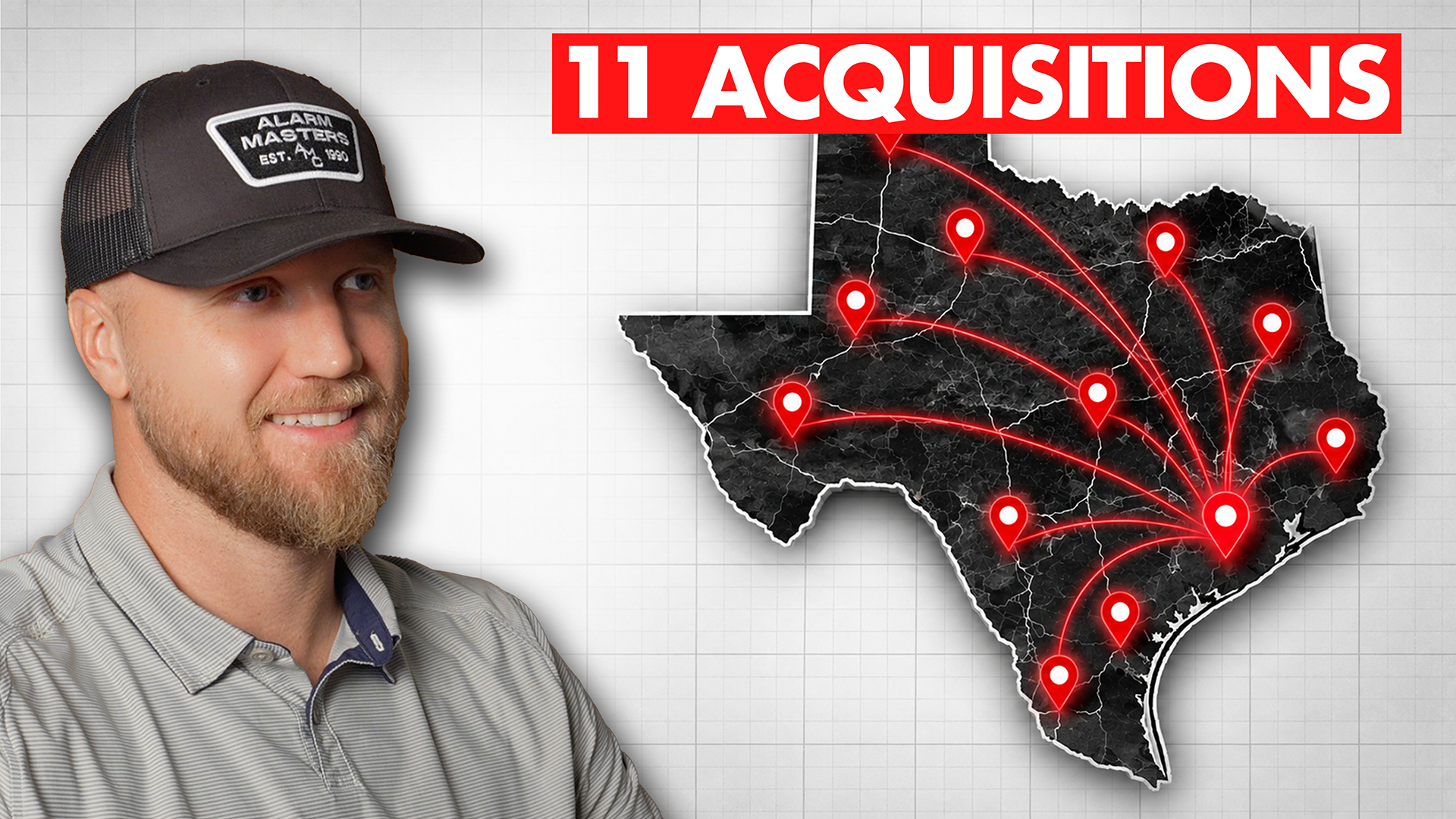
um all right, last last item, I mean there's obviously so many that we could highlight, but yeah, the last major driver of our growth um has been acquisitions and not only just making the acquisition, but what we do with it afterwards. You know, I think that we've done a good job, we're imperfect. Um, not every single acquisition has been just gone like great. Um we've had a couple ouchies, uh, mainly one. Um but even still we have extracted value out of all of those and upsell, cross-sell, just kind of like land and expand service, absolutely. And because m most of the companies, if not every single one that we've acquired, we're not running service like we do and kind of maximizing those accounts and the account value. So we've we've always been able to extract more revenue per account than the predecessor, frankly. Yeah, true of Alarm Masters Core, you know. Yep. Um so uh that's that's a strategy that we've used. Um a lot of those have been tuckens in the Houston area. Obviously, we've you know announced um publicly that you know we now have an operation in North Texas, um uh and we can start to kind of run that same tuck-in play. We're looking at other markets. Um, but again, if we sound like a broken record, but you can't even really do that well if you don't have the supporting team and infrastructure to go plot that on top of.
Yeah, I would I would say fundamentally you're you're probably gonna hit a ceiling. Not probably. I feel it within my bones that you're really gonna get capped, and I don't necessarily know where the cap is, but it's probably somewhere in the five to seven million dollars if you are not uh acquiring other businesses. Now, there are guys that are exceeding that cap that are doing construction and construction bid work exclusively, and so they get on to really big projects. Uh, and and there are people in the past that have scaled over that. I think that if you're starting today in or or whatever, if you're a two million dollar business today or three million or four million and you want to be a 10, 15, 20 million dollar business, you're probably not gonna get there unless you're doing acquisitions. I it's just I would say that we are growth experts. We're not operationally the very best, we're not financially the very best, but we are really good at growth. And I would tell you it's it would be impossible for us to get to where we want to be from an enterprise perspective without doing acquisitions. And that's I mean, man, we've recorded we've we've recorded so many minutes on acquisitions and putting in playbooks and how to do it. And we've had uh dozens of conversations with listeners saying, Hey, I want to do more acquisitions. Can you talk me through this?
Yeah.
Um, so go listen to some of the past episodes on that. And Stephen, like, what could they do if they want to hear more about that kind of stuff? Like if they want to hear more about acquisitions or yeah, phone affecting content.
Um no, they can they can subscribe, they can like, they can comment, um, check out the newsletter, share it with a loved one, um, print it out and take it to Thanksgiving here in a couple months. Maybe it can be a little material to talk over over the Thanksgiving dinner table. I'm sure your family in your LinkedIn would would they would really appreciate that. They'd say, Oh, yeah, actually, I was hoping that we could talk about security instead of like our loving family um at Thanksgiving. It'd be perfect. So if you do that and get bad feedback, please do not contact us. Yeah, please don't comment.
Um, thanks, have a great week. Thanks for listening.
.png)