

Growth solves a lot of problems—but it also creates new ones.
In this Founder Series episode of Entry & Exit, Stephen Olmon and Collin Trimble share a candid update on Alarm Masters' growth in 2026. They break down what's driving record performance, the acquisitions they're pursuing, the operational improvements paying off, and the challenges they're still working through.
From sales maturity and AI adoption to accounting headaches and inventory management, this is an inside look at what it actually takes to scale a service business.
In this episode:
→ How Alarm Masters is growing through acquisitions and organic sales
→ The sales lessons improving close rates and deal quality
→ Why operational discipline is creating better customer outcomes
→ The realities of GAAP accounting and preparing for an eventual exit
→ The role AI is playing across the business
→ The biggest challenges still ahead in 2026
→ What’s next for expansion into new markets
Connect:
Stephen Olmon — https://x.com/stephenolmon
Collin Trimble — https://x.com/TXAlarmGuy
Owned and Operated
New Episodes Every Wednesday!
Subscribe For More
The things that are not going great is our counting. It just did not appreciate or have enough reference for the absolute punch. That that is. Hey, I want you to set seven appointments a day. And I don't care how many calls you make, just go set like go be results focused rather than KPI driven. Entrepreneurship is like staring off into the abyss and chewing glass. Oh yeah. Yeah. It's like I feel that. If you're if you're gonna grow and you think you're ever gonna go raise debt or equity or sell your business, if you're gonna do one of those three things, start working on your books today. Welcome back to the founder series. Uh sorry. Okay, I'm gonna redo that. Cut.
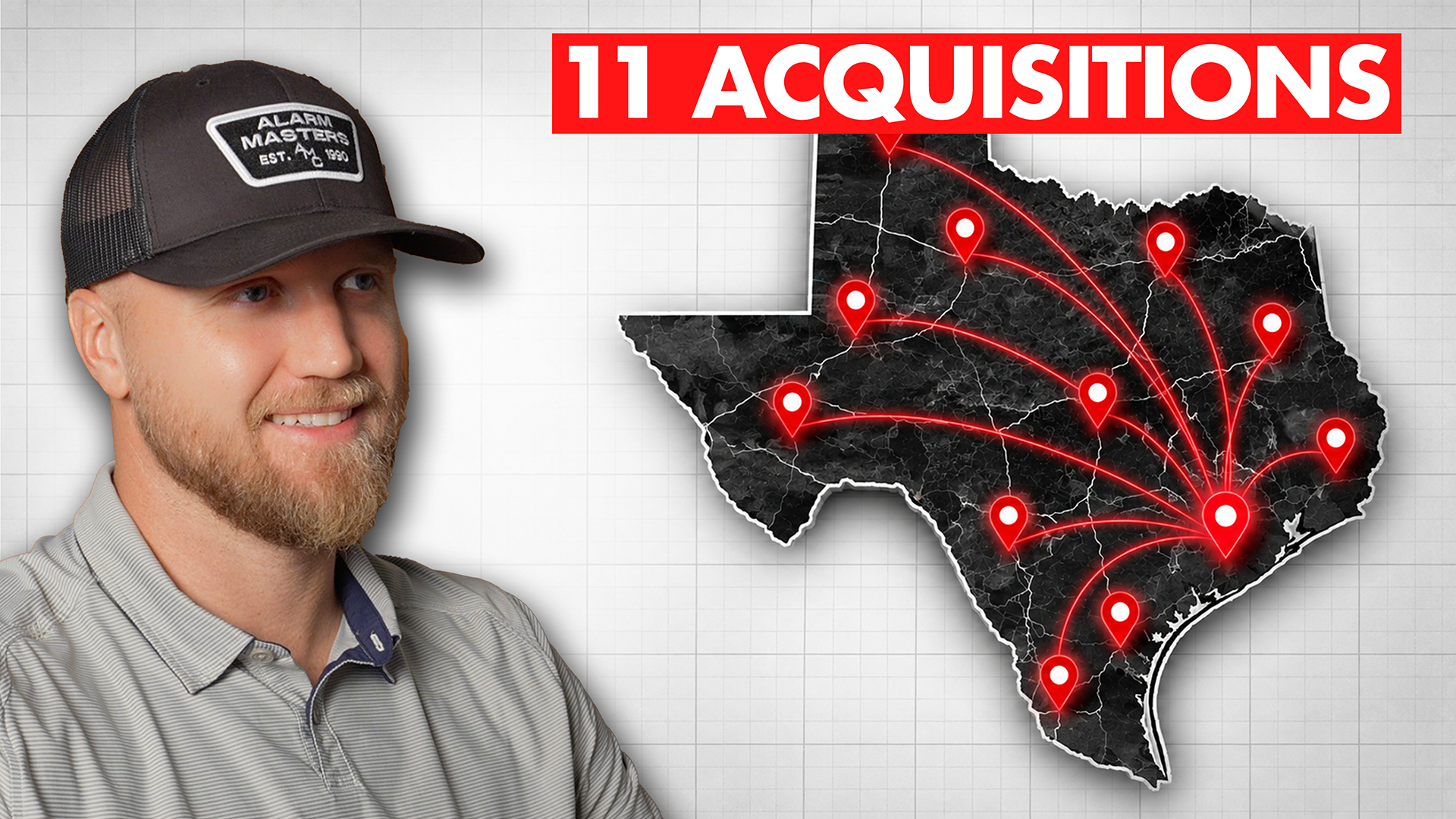
Welcome back to the founder series with entry and exit. I'm Steven Ullman. I also have Colin Trimble with me, my business partner, co-host, fearless leader in all the things. And today we're talking about the current state. So if you haven't listened to the founder series, go back. I think you'll have four or five episodes to peruse to catch up, then come back to this, and you can hear about what's going on right now. It's May 2026. There's a lot of fun stuff happening. And we'll we'll kind of reflect a little bit on what's really different between you know the previous years and now. And then we'll talk about some of the things that are the goings-on, as the kids say. The goings-on. Yeah. Um, if you haven't listened, there's also a uh playlist out there on YouTube where it shows you like all the founder series, because we've kind of gone from when we purchased the business to now. Um and it's labeled founder series, so maybe that's helpful. Um, where are we today? So we're sitting in May 2026. Um, and and I think what would what would the business look like today? So today we are growing massively both inorganically and organically. We will have done, we're projecting that by the end of June, so end of Q2, we will have done all of our EBITDA from all of last year on an organic basis. Um we are growing mostly through organic right now, although I say that we are also about to close on um two very strategic acquisitions. We have one that's a tuck-in here in the Houston area, and we have another one that we're working on in the Dallas and the Fort Worth area that we're really excited about. And so these are some strategic acquisitions that we're going after. And if you if you haven't listened or this you're new, you will know that like our strategy, our secret sauce, our magic bullet is we combine inorganic, meaning acquisitions and organic um growth via sales and marketing. Um, and we believe that those two things together um make the magic happen, right? We believe that those things um are what drives the value here. So um we have really matured in in a couple ways as it pertains to I would say the way that we're set up operationally right now is extremely tight. Every department has a director of that department. Some most departments now have a manager under that director. They have multiple reports below them. There is a mix of international employees and local employees underneath each director. Um, and we're we're kind of getting to a place now where we're even adding like additional managers to departments, right? So there's even more layers of organization that are happening. Um and we're also really what's what's been great on the sales side, then I'll let you kind of chime in, Stephen,
on some of your perspective. On the sales side, we are maturing drastically in all the metrics we care about, which is cycle time. We're going from like 60 to 90 days or sorry, 60 to 75 days down to like 45 days. Our average ticket or average opportunity value is going way up. I mean, it's double the size of what it was this time last year. Our sales process is very rigorous. I had a conversation with a sales guy yesterday. I told you about this, Stephen, that um a sales guy, shout out Jordan, by the way. Um Jordan. We, you know, I've been hammering the ABC, right? Or bank criteria. So it's budget uh authority, budget, and compelling event. And we went on a walk together on this particular customer, and he asked me to come out and he took it super strategic. And we went out there as a you know, decent-sized project, but we were meeting with basically um the executive assistant is essentially who it was. And she said that she's the one that was going to be making the the decision. And I asked if they had a budget, she said no, we don't really have a budget for it. And then I asked her about if you know why are they choosing to do this now? And they just said, Oh, we just have been meaning to get to it, we just haven't done it. And I walk and but she was like giving Jordan, like Jordan was like jacked. He was like, dang, this is you know, we think we may actually close this. And I told him this is a month ago, and it ended up not closing. And I told him, I told him while we were in the parking lot, I was like, dude, dude, this is not gonna close. Like, this deal is not gonna close. Like, you don't have the budget. And he and he was this was when he was fairly new. And then the deal ended up not closing. And then yesterday we had a conversation and he said, you know, I've been thinking about that that deal that we didn't win, and I've been thinking about some other deals, and I'm realizing now that like over the last 60 days, since I've been basically disqualifying any customer that doesn't have budget and won't give us access to power, that like my closer rate is going up. Yeah, like I'm actually closing more deals, and like my pipe gin hasn't necessarily gone down, but I'm closing more deals. And he goes, I always think about that deal you told me we weren't gonna close because we didn't have access to power and we had no compelling event and budget. And now I'm realizing like those three indicators, and so it's just like an example of maturity within the sales group. Yes, right? It's just like we're growing, we're doing the right things, which that's um that's happening across really every department, you know. Like you see those little light bulb moments are where, you know, there's you know, at times kind of a train the trainer mentality and it's like kind of trickling down, and um kind of like the the moments of delight, right? Where you work so hard and then you see the fruit of that, and we're seeing that in several different departments. Um, I mean, I think about what we're doing from a collections perspective now versus 12 or 24 months ago, night and day. Um also from a technology perspective, like you've banged the gong of customer 360, now we're here, you know, what it was 24 months ago till today is like a completely different company from a technology perspective. And I'm very grateful that you did push so hard on that. And so now we're actually really realizing the benefits of all of that and all these different things that we're doing are all built on top of it. And so we've really gotten to the point where the hard work, the investment that we did, where now we're getting to sit back and be like, dude, this is really working. And that's it's fun. Um, it was kind of like what's the quote from the Elon Musk, the first that Ashley Vance did the biography is like entrepreneurship is like staring off into the abyss and chewing glass. Oh yeah. Yeah, it's like I feel that, but but now it it's it's uh not so bad. No, it is. It's when you are in their early days and you're kind of bootstrapping everything together, it's so stressful, and you're so you're like checking your bank account balance every single day, and you're just like, oh my gosh, everything is like going wrong all the time. And like we still deal with fire, you know, fire alarms every night, pun intended. Um, but it just has gotten significantly
better. And then on the ops side, too, man, like we're just so much more dialed. Like we're doing project handoffs, and it's like we used to do project handoffs for really big projects. Now we do once a week, all projects are getting handed off, and the collab level of collaboration between the ops team and the sales team. And what's really great is the sales team is helping the ops team because the ops team now has a greater perspective of what the customer is expecting outside of just a scope of work. Right. And the sales team is learning what the ops team needs in those handoffs. So our handoffs are getting faster, more efficient. We're beating our project bids uh, like from an hour perspective. Uh, we're beating our labor budget, is what I'm trying to say. And and it's just it's clicking on that project side in a in a big way. Yeah. Um, and then on the service side, like we're what we use services. Service is a revenue generator, that is a revenue generation department. And and shout out to our director of ops because we had we have this this um service administrator on our team who's great. And he was making phone calls to try to set appointments for our um for our like fail to communicate, fail to test, whatever. And so we were trying to give him like kind of a target like, hey, why don't you try to make like 50 calls a day against this list to try to set some appointments for the service team? And um my director of ops came and said, Hey man, I really want to change that. Like, we know what our goal needs to be, we know what our average ticket value is. Can I just give him like, hey, I want you to set seven appointments a day? And I don't care how many calls you make, just go set like go be results focused rather than KPI driven. I was like, sure, let's try it. Well, sure enough, he's hitting it. And actually, he's exceeding it in less calls. And it was just like a frame of reference change that showed me that our director of ops, and this guy has a boss between him. So there's a service manager between them. It just shows me how in tune the director of ops is with his team and how like dialed the team is like, oh, okay, yeah, I get this. Like the goal here is not phone calls, the goal here is like set appointments to like protect these customers, make sure we can fix their systems. And so that all that stuff is going great. Like, we're really dialed, we've got a great pipeline, like I'm feeling really good
about it. There's some things that are not going great. And the things that are not going great is our accounting and and our books has just been tough. We transitioned from cash to accrual in 24 to 25. Gap, true gap accounting is really hard if you sell one type of pencil. Yeah. If if you are doing thousands of different SKUs and a bunch of different scopes of work to a bunch of different types of customers with all sorts of different billing cadences, and and and and and wow. Um, just so deeply did not appreciate or have enough reference for the absolute punch in the teeth that that is. And so uh we are what I will say is going well is that we're working with the right people, we're taking the right steps, and there's a lot of positive changes we're making in our process, yeah, such that I I feel way better sitting here today looking kind of go forward, but man, um it quite a journey that's been. It was just messy and it's just hard, and it was like it nothing materially changed in our finances, and it was just the way that all of it ties together and like the reporting on the back end of it that actually matters if you're gonna go get senior debt or if you're gonna raise money or whatever, like that stuff matters. And so the cleanup effort we're doing has just been really challenging and it's just not as it was not as tight as we wanted, and it's a lot better now. And we've talked about this before, but like if you're if you're gonna grow and you think you're ever gonna go raise debt or equity or sell your business, if you're gonna do one of those three things, start working on your books today. And probably if you're over a million dollars of EBITDA, you need to start really evaluating going from cash to to gap or andor accrual accounting. You're gonna end up you're gonna end up getting evaluated on that anyways, you know, like external parties, diligence, you know, or you know, audit, you know, anything like that. They're going to look at your business in that way, anyways. And so you might as well become really well versed and understand how others are going to come and from a sophisticated perspective, evaluate your business. So that's that's one thing. What else? What's what's something else that we haven't quite cracked? Yeah,
I would say another thing that I think a lot about that we haven't cracked is our purchasing strategy and like our inventory management is not tight. Like it's we want it to be tight. It's not like we don't know what our inventory is. We have to for gap accounting, but it's not super well defined. It's not we're buying parts that we have in stock more than I'd like to. We're not getting multiple bids every time we purchase something. Uh, I talked to a friend who's got a shop up in Dallas, and he was telling me that um every time they order a part, they've they uh they buy uh they go get three bids. And I'm like, dang, dude, like you're super smart. He's like, yeah, man, my team is dialed. Like every time we go and we get three separate bids to find the best price, and like they track where they purchase it and they track like from an inventory, like a warranty timeline so that they can RMA certain price. I mean, it's just really, really tight. It's really impressive. And that is something that we have not even scratched the surface on, and we need to. Um, and um, you know, there's there's some stuff there. There's some stuff with like auditing um where we are from a like um like we have contracts for our customers, but those contracts are not tied into Salesforce, and so there's this like gap of are you looking at the right document in Google Drive that's the latest contract to know where the customer is and doing amendments? And it's like, okay, we added a service and they had a base contract, so we did a second contract and they're not co-termed. So we've got two contracts. I don't know. There's there's some like clerical contract work we've got to do to clean up. So those would be the two or three accounting uh inventory/slash purchasing and the contract stuff that I would say really are our biggest pain points. Yeah, one other thing we haven't cracked that I'm really motivated to is uh on the paid side uh from a marketing perspective. Paid ads. Um, I mean, we have a very strong pipeline. We really haven't had an issue with leads. Um, there's a bunch of different ways that we go about that today, but I just come from a background of like $1 in, $3 out, just raw math, like ROI from a paid ads perspective. And it's an interesting industry to craft that in. Um, but I think certain scopes, like very certain personas, the more specific we can get, the better we'll be. And so I'm hoping that in the next kind of six to nine months that we end up kind of getting to a next phase of that and get more mature there. Yeah, yeah, I do too. I I want to say, I want to close with what are we gonna define as like uh what are the kind of near-term priorities for us as a as a company and like what are we hyper focused on right now? And so, like, what are the leading KPIs? So we are really focused on a couple things. We're really focused on our EBITDA number. Um, we're hyper focused on growing our EBITDA year over year and making sure we have very significant growth on that EBITDA. Um, we are very focused on limiting our attrition to as close to zero as we can possibly get. We are extremely focused on using AI to enable our employees. Um we are a subscriber to the don't replace enhance uh philosophy. Um and we are have a lot of really big plans for how to continue to use AI in our business and have already been using it in a really big way in lots of really fun ways. Um and then I would say the last thing is we are doing bigger and bigger acquisitions, and doing those acquisitions with excellence is really important to us. So we kind of shifted one of our directors who was over Customer Success, who kind of already was involved tangentially in integrating. He's kind of owning that process for us now. And we really want to make sure that we do these with excellence and that we don't overstack and do too many where we're not delivering a good experience to customers and we limit attrition for those. So those would be the ones that I would say are kind of the biggest near term. Do you have anything to add to that? Yeah, the only other thing, I mean, just specific to acquisitions, like we just we do want to be in other markets. You know, we've done most of our revenues derived in the kind of greater Houston area. I mean, we kind of define that loosely, like there that's a yeah, that's a large radius, but um, we're just excited to to be in other markets, and it's something that we've kind of flirted with in the past, but it seems like we're really close to that. And so I'm I'm really excited. For those of you who don't know, I live in DFW, so I'm a North Texas homer, just bias because it's the greatest market in the country for business. And so I'm stoked about that. Yeah, yeah, for sure. Super excited about that. Um, we are gonna continue to do these founder series on some interval. We kind of got caught up to where we are current state. And if you want to hear more, if there's specific things you want to hear about our business, let us know. We'd love to share more about that because we can go deeper on some specific things. We're really we're doing a lot of really fun stuff on the sales side, like targeting compelling events and open source data and lots of crazy stuff uh that we like to talk about. So let us know what you want to hear more about. We appreciate a subscribe, a comment, forward to your friends, whatever. We like really appreciate that. And yeah, we appreciate you listening.
.webp)
.png)